
← All marine life
Roughtail Stingray
Species IUCN · Vulnerable (VU)

Roughtail Stingray

Bathytoshia centroura, (Mitchill, 1815)

marinebrackish

About Roughtail Stingray

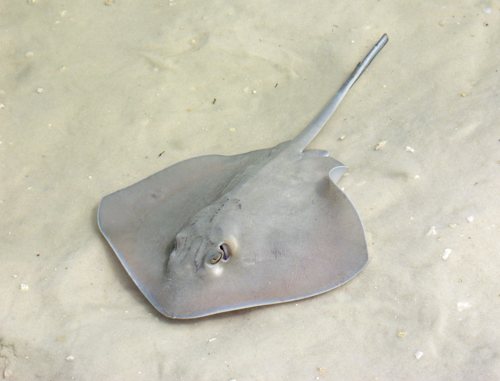
The roughtail stingray (Bathytoshia centroura) is a species of stingray in the family Dasyatidae, with separate populations in coastal waters of the northwestern and southwestern Atlantic Ocean. This bottom-dwelling species typically inhabits sandy or muddy areas with patches of invertebrate cover, at a depth of 15–50 m (49–164 ft). It is seasonally migratory, overwintering in offshore waters and moving into coastal habitats for summer. The largest whip-tail stingray in the Atlantic, the roughtail stingray grows up to 2.6 m (8.5 ft) across and 360 kg (800 lb) in weight. It is plain in color, with an angular, diamond-shaped pectoral fin disc and a long, whip-like tail bearing a subtle fin fold underneath. The many thorns on its back and tail serve to distinguish it from other stingrays that share its range.

Often found lying on the bottom buried in sediment, the roughtail stingray is a generalist predator that feeds on a variety of benthic invertebrates and bony fishes. It is aplacental viviparous, with the embryos receiving nourishment initially from yolk, and later from histotroph ("uterine milk") produced by the mother. The venomous tail spine of the roughtail stingray is potentially dangerous to humans. The International Union for Conservation of Nature (IUCN) has listed this species as vulnerable overall.

Appearance

The roughtail stingray has a diamond-shaped pectoral fin disk 1.2–1.3 times as wide as long, with straight to gently sinuous margins, rather angular outer corners, and a moderately long, obtuse snout. The eyes are proportionally smaller than other stingrays in its range and immediately followed by larger spiracles. There is a curtain of skin between the nostrils with a finely fringed posterior margin. The mouth is bow-shaped with a row of six papillae (nipple-like structures) across the floor. The seven upper and 12–14 lower tooth rows at the center are functional, though the total number of tooth rows is much greater. The teeth are arranged with a quincunx pattern into flattened surfaces; each has a tetragonal base with a blunt crown in juveniles and females, and a pointed cusp in adult males.
Habitat

The roughtail stingray is broadly but discontinuously distributed in the coastal waters of the western Atlantic Ocean. It occurs from the Georges Bank off Cape Cod, Massachusetts following warm ocean waters southward to Florida, the Bahamas, and the northeastern Gulf of Mexico; there are also scattered reports from Venezuela to Argentina and on the Barrier reef in Belize. A single record from Kollam, India was likely a misidentification.

One of the deepest-diving stingrays, the roughtail stingray has been recorded to a depth of 274 m (899 ft) in the Bahamas. However, it is most common at a depth of 15–50 m (49–164 ft). This bottom-dwelling species favors live-bottom habitat (patches of rough terrain that are densely encrusted by sessile invertebrates), and also frequents adjacent open areas of sand or mud. Rays in the northwestern Atlantic do not usually enter brackish water.

Behaviour

The roughtail stingray is reportedly not highly active, spending much time buried in the sediment. It is a generalist predator whose diet generally reflects the most available prey in its environment. It mainly captures prey off the bottom, but also opportunistically takes free-swimming prey. A variety of invertebrates, as well as bony fishes such as sand lance and scup, are known to be consumed. Off Massachusetts, the main prey are crabs (Cancer), bivalves (Mya), gastropods (Polinices), squid (Loligo) and annelid worms. In Delaware Bay, most of its diet consists of the sand shrimp Crangon septemspinosa and the blood worm Glycera dibranchiata; the overall dietary composition there is nearly identical to that of bluntnose stingrays (Hypanus say) that share the bay. The shrimp Upogebia affinis is a major food source off Virginia.

Humans & conservation

With its large size and long, venomous spine, the roughtail stingray can inflict a severe wound and can be very dangerous for fishers to handle. However, it is not aggressive and usually occurs too deep to be encountered by beachgoers. It has been reported to damage farmed shellfish beds. The pectoral fins or "wings" are sold for human consumption fresh, smoked, or dried and salted; the rest of the ray may also be processed to obtain fishmeal and liver oil. The International Union for Conservation of Nature (IUCN) has assessed the roughtail stingray as of Least Concern worldwide, while noting that as a large, slow-reproducing species it is susceptible to population depletion.

Part of

Where to see it

No dive sites list Roughtail Stingray yet. Explore the map to find sites near you.