
← All marine life
Ross Seal
Species IUCN · Least Concern (LC)

Ross Seal

Ommatophoca rossii, Gray, 1844

marine

About Ross Seal

The Ross seal (Ommatophoca rossii) is a true seal (family Phocidae) with a range confined entirely to the pack ice of Antarctica. It is the only species of the genus Ommatophoca. First described during the Ross expedition in 1841, it is the smallest, least abundant and least well known of the Antarctic pinnipeds. Its distinctive features include disproportionately large eyes, whence its scientific name (Ommato- meaning "eye", and phoca meaning "seal"), and complex, trilling and siren-like vocalizations. Ross seals are brachycephalic as they have a short broad muzzle, and also have shorter fur than any other seal.

Appearance

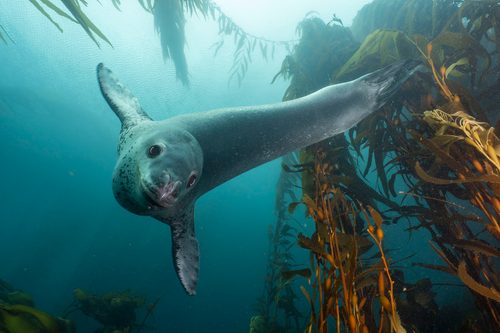
Ross seal males reach a length of about 1.68–2.09 m (5.5–6.9 ft) and weight of 129–216 kg (284–476 lb); females are slightly larger at 1.96–2.5 m (6.4–8.2 ft). A molecular genetic based technique has been established to confirm the sex of individuals in the laboratory. Pups are about 1 m (3.3 ft) and 16 kg (35 lb) at birth. The coat is colored dark-brown in the dorsal area and silvery-white beneath. At the onset of the Antarctic winter, the coat fades gradually to become light brown. At close range, the Ross seal can be easily identified by its large eyes, which are up to 7 cm (2.8 in) in diameter. In comparison to other Monachinae, Ross seals have a short muzzle.
Habitat

Although its close relatives Weddell seals, crabeater seals and leopard seals are ubiquitous in Antarctic waters, the Ross seal is an uncommon and relatively unknown animal, considered to be the least common pack ice seal. It almost never leaves the Antarctic Ocean, with the very rare exception of stray animals found around subantarctic islands, and uniquely, off the south coast of Australia. Evidence suggests the seal inhabit the pack ice in the Weddell Sea as well, though only in the Spring during breeding seasons. Nonetheless, its distribution is circumpolar, with individuals found in low densities - usually singly - in very thick pack ice in all regions of the continent.

Diet

Ross seal feeds primarily on 19% invertebrates, 47% squid and 34% fish, primarily Antarctic silverfish, in the pelagic zone. Competition with whales or other arctic seals reduces their highly specialized diet. Ross seals are presumed to be preyed upon by killer whales (Orcinus orca) and leopard seals, large predators that share their Antarctic habitat, though there are no documented observations of predation. Haul-out behavior among Ross seals varies seasonally, with a preference for midday haul-outs observed in certain months (September, October, February, and December). The Ross seal is a solitary species, therefore they do not gather in large breeding season. Additionally, during the breeding season, female seals entering the pack ice engage in continuous haul-outs lasting 5 to 7 days.

Part of

Where to see it

No dive sites list Ross Seal yet. Explore the map to find sites near you.