
← All marine life
Ringed Seal
Species IUCN · Least Concern (LC)

Ringed Seal

Pusa hispida, (Schreber, 1775)

marine

About Ringed Seal

The ringed seal (Pusa hispida) is a small earless seal species found in Arctic and sub-Arctic regions. Its common name is derived from a distinctive patterning of dark spots surrounded by light gray rings.

The ringed seal is the most abundant and wide-ranging ice seal in the Northern Hemisphere; they can be found throughout the Arctic Ocean, into the Bering Sea and Okhotsk Sea as far south as the northern coast of Japan in the Pacific, and throughout the North Atlantic coasts of Greenland, Baltic Sea, Scandinavia as far south as Newfoundland. Two freshwater subspecies live in northern Europe. They are the smallest members of the seal family found in these regions, averaging 1.5 metres (5 ft) in length.

The average lifespan of a ringed seal is 40 years. They have a solitary lifestyle, and their diet consists mostly of Arctic cod and planktonic crustaceans. They are a primary prey of polar bears – which are their primary predator – and killer whales, and have long been a component of the diet of indigenous people of the Arctic.

Recently, the biggest threat to ringed seals has been the changing temperature in the Arctic and the detrimental changes to sea ice that follow. Declines in snowpack and sea ice due to increasing ocean temperatures and atmospheric temperatures poses a threat to their survival. However, some projections indicate that the extinction of their predators due to warming may ultimately allow ringed seal numbers to thrive.

Appearance

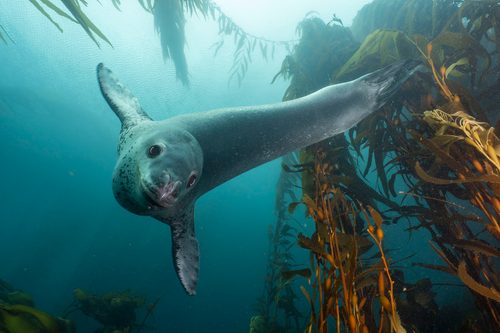
The ringed seal is the smallest and most common seal in the Arctic, with a small head, short cat-like snout, and a plump body. Its coat is dark with silver rings on the back and sides and a silver belly, giving this seal its vernacular name. Depending on subspecies and condition, adult size can range from 100 to 175 cm (39.5 to 69 in) and adult weight can vary from 32 to 140 kg (71 to 309 lb). Its average length is about 5 ft (1.5 m) long, with an average weight of about 50–70 kg (110–150 lb). Though it is generally considered the smallest species in the true seal family, several related species, especially the Baikal seal, may approach similarly small dimensions. Their small front flippers have claws more than 2.5 cm (1 in) thick that are used to maintain breathing holes through ice sheets as thick as 6 ft (1.8 m).
Habitat

Ringed seals occur throughout the Arctic Ocean. They can be found in the Baltic Sea, the Bering Sea and the Hudson Bay. They prefer to rest on ice floe and will move farther north for denser ice. Two subspecies, P. h. saimensis and ladogensis, can be found in freshwater.

Diet

Ringed seals are an important food item in particular for polar bears. During the pupping season, Arctic fox and glaucous gulls take ringed seal pups born outside lairs while killer whales, Greenland sharks and occasionally Atlantic walruses prey upon them in the water.

Behaviour

Females reach sexual maturity at 4 years old while males do not reach maturity until 7 years old. During the spring breeding season, females construct lairs within the thick ice and give birth in these structures. Females give birth to a single pup on ice floes or shorefast ice in March or April after a 9-month gestation period. Pups are weaned after two months and build up a thick layer of blubber.

Females usually begin mating in late April. Males will roam the ice for a mate. When found, the male and female may spend several days together before mating, after which the male looks for another mate.

Ringed seals live about 25 to 30 years. They are solitary animals and when hauled out on ice, they separate themselves from each other by hundreds of yards.

Humans & conservation

Evidence of human hunting of ringed seals dates to the Middle Paleolithic, as ringed seal limb bones were excavated from the Neanderthal site at Gruta da Figueira Brava, in Portugal, from layers dated to the Last Interglacial-Last Glacial Period transition.

Ringed seals have long been an important component of the diet of Arctic indigenous peoples throughout their range, and continue to be harvested annually by many communities. Early Paleoeskimo sites in Arctic Canada revealed signs of harvested ringed seals dating from c. 4000–3500 BP, likely captured in frozen cracks and leads in the ice, with a selection for juveniles and young adults.

In 2012 the Government of Nunavut warned pregnant women to avoid eating ringed seal liver due to elevated levels of mercury, although they stressed eating traditional "country food" is still healthy for adults.

Part of

Where to see it

No dive sites list Ringed Seal yet. Explore the map to find sites near you.