
← All marine life
Red Hind
Species IUCN · Least Concern (LC)

Red Hind

Epinephelus guttatus, (Linnaeus, 1758)

marine

About Red Hind

The red hind (Epinephelus guttatus), also known as the koon or lucky grouper in Caribbean vernacular, is a species of marine ray-finned fish, a grouper from the subfamily Epinephelinae which is part of the family Serranidae, which also includes the anthias and sea basses. It is native to the western Atlantic Ocean where it ranges from the eastern United States to Brazil. It is the most common species of Epinephelus in the Caribbean and Bermuda.

Appearance

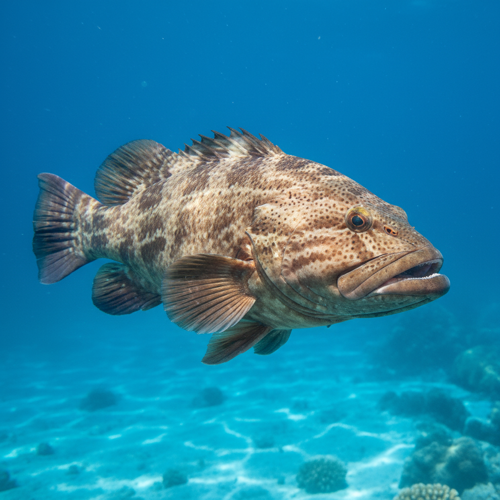
The red hind has a robust, compressed body which is deepest at the origin of the dorsal fin, the standard length being 2.7 to 3.1 times the depth. The gill cover has three flat spines on its margin. The preopercle has a finely serrated margin and protrudes slightly near its lower edge. The dorsal fin contains 11 spines and 15-16 soft rays while the anal fin has 3 spines and 8 soft rays. It has a slightly convex tail. This species is greenish grey to light brown on its upper body fading to white on the lower body, with many well-spaced dull orange-red to brown spots covering the head, body and fins. There are five indistinct oblique bars made up of darker spots on the flanks. This species attains a maximum total length of 76 centimetres (30 in), although they are more commonly around 40 centimetres (16 in) in length, and the maximum published weight is 22 kilograms (49 lb).
Habitat

The red hind is found in the Western Atlantic. Its range extends from Bermuda and North Carolina and along the eastern coast of the United States into the Gulf of Mexico and the Caribbean. Its range is said to extend south as far as Brazil but there are no confirmed records from south of Venezuela.

Part of

Where to see it

No dive sites list Red Hind yet. Explore the map to find sites near you.