
← All marine life
Red Grouper
Species IUCN · Vulnerable (VU)

Red Grouper

Epinephelus morio, (Valenciennes, 1828)

marine

About Red Grouper

The red grouper (Epinephelus morio) is a species of marine ray-finned fish, a grouper from the subfamily Epinephelinae which is part of the family Serranidae, which also includes the anthias and sea basses. It is found in the western Atlantic Ocean.

Appearance

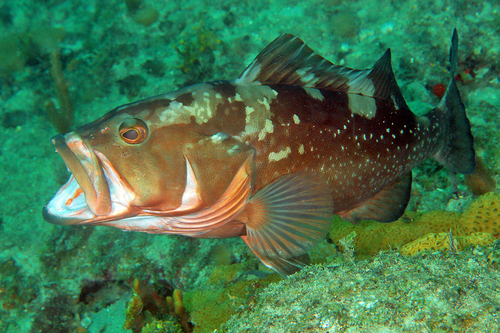
The red grouper has a body with a standard length which is 2.6 to 3 times as long as it is deep. The preopercle is subangular with the serrations at its angle being slightly enlarged and the upper edge of the gill cover is straight. The gill cover has three flat spines with the central spine being the longest. The dorsal fin contains 11 spines and 16 or 17 soft rays while the anal fin has three spines and eight soft rays. The pectoral fins are longer than the pelvic fins and the caudal fin is truncate. The pelvic fins insert posterior to the insertion site of the pectoral fins. Red grouper are dark reddish brown on the upper part of the head and body, shading to paler pink on the underparts. They are marked with lighter spots and blotches across their body and there are darker margins to the fins.

Habitat

The red grouper's typical range is coastal areas in the western Atlantic, stretching from southern Brazil to North Carolina in the US and including the Gulf of Mexico and Bermuda. It lives in areas with wide continental shelves and is considered to be a neritic species.

Humans & conservation

The International Union for Conservation of Nature has classified the red grouper as a vulnerable species. It is estimated to have declined globally by at least 30 percent over three generations or 51 years. The major threat to the species' survival is overfishing, with possible contributions in the Gulf of Mexico from hypoxia, algal blooms, oil and gas exploration and increasing sea temperatures due to climate change.

Part of

Where to see it

No dive sites list Red Grouper yet. Explore the map to find sites near you.