
← All marine life
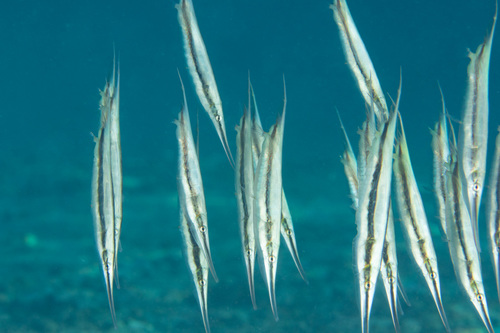
Razorfish
Group

Razorfish

Labridae, Cuvier, 1816

marinebrackish
Where to see it

About Razorfish

The wrasses are a family, Labridae, of marine ray-finned fish, many of which are brightly colored. The family is large and diverse, with over 600 species in 81 genera, which are divided into eight subfamilies.

They are typically small, most of them less than 20 cm (7.9 in) long, although the largest, the humphead wrasse, can measure up to 2.5 m (8.2 ft). They are efficient carnivores, feeding on a wide range of small invertebrates. Many smaller wrasses follow the feeding trails of larger fish, picking up invertebrates disturbed by their passing. Juveniles of some representatives of the genera Bodianus, Epibulus, Cirrhilabrus, Oxycheilinus, and Paracheilinus hide among the tentacles of the free-living mushroom corals and Heliofungia actiniformis.

Appearance

Wrasses have protractile mouths, usually with separate jaw teeth that jut outwards. Many species can be readily recognized by their thick lips, the inside of which is sometimes curiously folded, a peculiarity which gave rise to the German name of "lip-fishes" (Lippfische), and the Dutch name of lipvissen. The dorsal fin has 8 to 21 spines and 6 to 21 soft rays, usually running most of the length of the back. Wrasses are sexually dimorphic. Many species are capable of changing sex. Juveniles are a mix of males and females (known as initial-phase individuals), but the largest adults become territory-holding (terminal-phase) males.

Habitat

Most wrasses inhabit the tropical and subtropical waters of the Atlantic, Indian, and Pacific Oceans, though some species live in temperate waters: the Ballan wrasse is found as far north as Norway. Wrasses are usually found in shallow-water habitats such as coral reefs and rocky shores, where they live close to the substrate.

Behaviour

Most labrids are protogynous hermaphrodites within a haremic mating system. A good example of this reproductive behavior is seen in the California sheephead. Hermaphroditism allows for complex mating systems. Labroids exhibit three different mating systems: polygynous, lek-like, and promiscuous. Group spawning and pair spawning occur within mating systems. The type of spawning that occurs depends on male body size. Labroids typically exhibit broadcast spawning, releasing high numbers of planktonic eggs, which are broadcast by tidal currents; adult labroids have no interaction with offspring. Wrasses of a particular subgroup of the family Labridae, Labrini, do not exhibit broadcast spawning.

Humans & conservation

In the Western Atlantic coastal region of North America, the most common food species for indigenous humans was the tautog, a species of wrasse. Wrasses today are commonly found in both public and home aquaria. Some species are small enough to be considered reef safe. They may also be employed as cleaner fish to combat sea-lice infestations in salmon farms. Commercial fish farming of cleaner wrasse for sea-lice pest control in commercial salmon farming has developed in Scotland as lice busters, with apparent commercial benefit and viability.

Species in this group

Where to see it

Top-rated dive sites where divers have spotted Razorfish.

Nungwi Beach

Nungwi Beach

⭐ 3.0 Scout Score
Shallow, lively resort with rich macro life, ideal for beginners.
👣 Shore Beginner