
← All marine life
Plainfin Midshipman
Species IUCN · Least Concern (LC)

Plainfin Midshipman

Porichthys notatus, Girard, 1854

marine

About Plainfin Midshipman

The plainfin midshipman (Porichthys notatus) is a species of bottom-dwelling batrachoid toadfish. It is a member of the midshipman genus, Porichthys, the only batrachoid fishes that have photophores. It is native to the North American coast of the Pacific Ocean, where its distribution extends along the coast from Sitka, Alaska, to Magdalena Bay in southern Baja California. There it inhabits shallow waters and will make migrations every spring to the rocky intertidal zones of the coast to breed.

The "midshipman" name comes from the line of photophores found on their body; they are positioned similarly to the uniforms of midshipmen—the lowest-ranking naval officer of any navy. This fish is the "plainfin" in comparison to another midshipman species, the specklefin midshipman.

The plainfin midshipman is known for its "singing" abilities. During breeding, both male and female fish will vocalize to attract mates. The sound is well known among houseboat residents and has earned the fish nicknames of the "California singing fish," or the "Humming Toadfish," as well as becoming the namesake for The Sausalito Humming Toadfish Festival.

Appearance

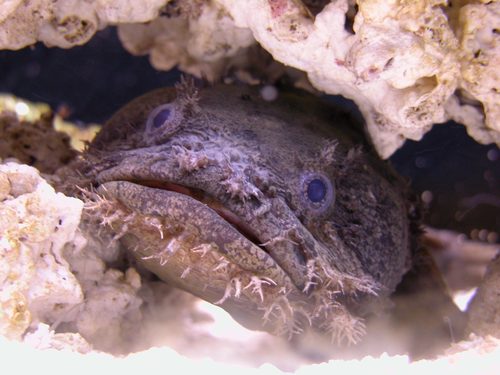
This fish reaches up to 38 cm (15 in) in length, and is one of the largest of the Porichthys toadfishes. It is brownish to olive to iridescent purple dorsally, becoming lighter on the sides and yellowish/golden on the belly, though this can depend on sex. Below the eye is a whitish patch and black crescent. Adults usually lack saddle-marks, but there are 6-7 saddle-marks if they are present. A young individual looks like an adult but may have a few dark saddle-marks. P. notatus has wide pectoral fins and a narrow but rounded tail fin. There are four lateral lines on the head and sides of the body.It has 33-38 soft rays in the long second dorsal fin, 30-35 anal rays, and 17 - 20 pectoral rays. The length of the fish varies from female to males. It is distinguished from other fish in its genus by the positioning of its photophores.
Habitat

During the nonbreeding season, the plainfin midshipmen typically inhabit moderately deep ocean waters off the Pacific coast of North America, from Canada to Baja California. They can range from shallow water just below the tide to depths of 366 m and prefer sandy and muddy bottoms.

Diet

Its diet includes crustaceans and fish. It is nocturnal, feeding at night and resting during the day, when it buries itself in the sand. As juvenile, they feed on small crustacean larvae and zooplankton.

Reproduction

During the late spring and early summer, they migrate from the depths to the intertidal zones of the coast to breed. For example, in Monterey, California, they come from canyons to seek outcroppings in shallow intertidal zones. They can be found by lifting up rocks or logs in the intertidal zones during this season.

This fish is oviparous, and the male is dimorphic, designated as Type I and Type II.

Humans & conservation

P. notatus is not a threatened species. It is widespread and apparently not in decline.

Part of

Where to see it

No dive sites list Plainfin Midshipman yet. Explore the map to find sites near you.