
← All marine life
Toadfish
Group

Toadfish

Batrachoididae, Jordan, 1896

marinebrackishfreshwater

About Toadfish

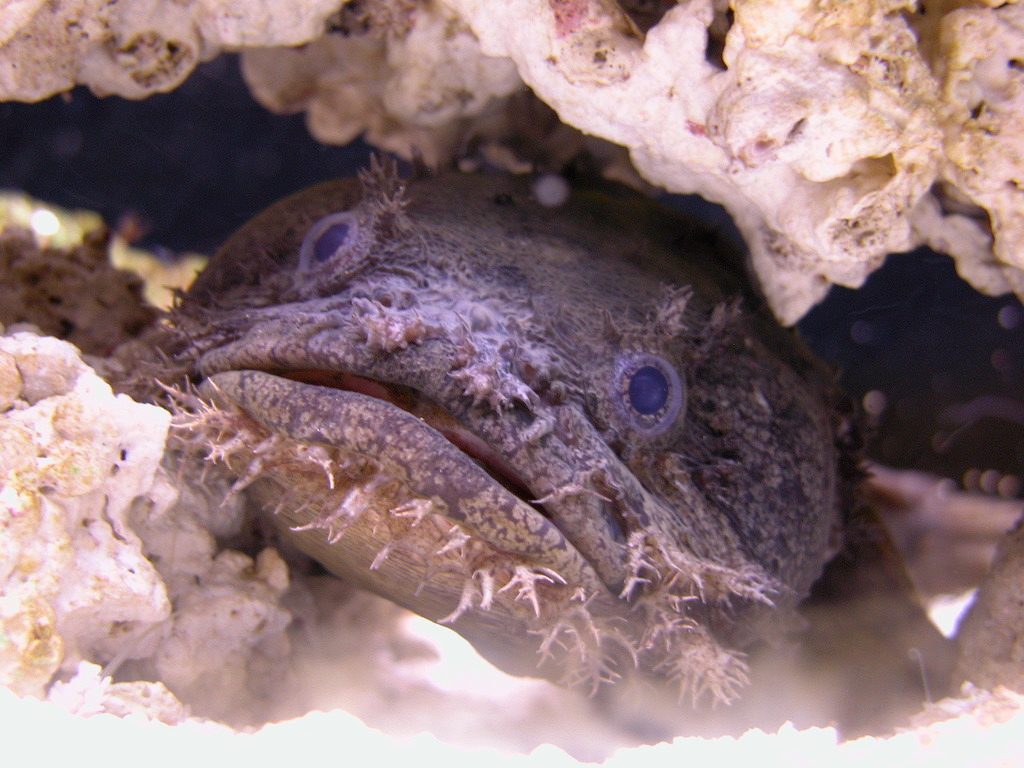
Batrachoididae is the only family in the ray-finned fish order Batrachoidiformes . Members of this family are usually called toadfish or frogfish: both the English common name and scientific name refer to their toad-like appearance (batrakhos is Greek for frog).

Toadfish are benthic ambush predators that favor sandy or muddy substrates where their cryptic coloration helps them avoid detection by their prey. Toadfish are well known for their ability to "sing", males in particular using the swim bladder as a sound-production device used to attract mates.

Appearance

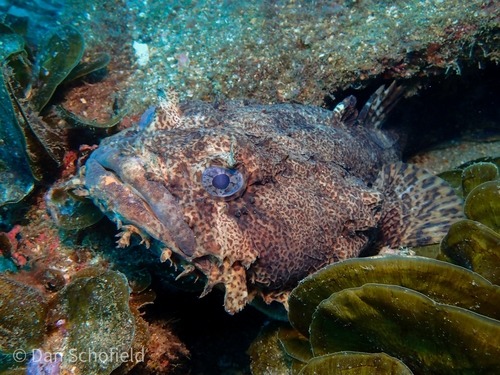
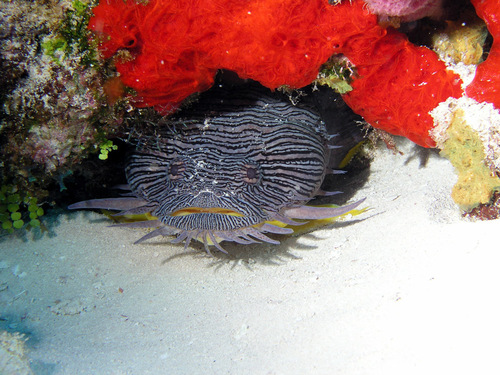
Toadfish are usually scaleless, with eyes set high on large heads. Their mouths are also large, with both a maxilla and premaxilla, and often decorated with barbels and skin flaps. They are generally drab in colour, although those living on coral reefs may have brighter patterns. They range in size from 7.5 cm (3.0 in) length in Thlassophryne megalops, to 57 cm (22 in) in the Pacuma toadfish.

The gills are small and occur only on the sides of the fish. The pelvic fins are forward of the pectoral fins, usually under the gills, and have one spine with several soft rays. For the two separate dorsal fins, the first is smaller with spines, while the second has from 15 to 25 soft rays. The number of vertebrae range from 25 to 47.
Habitat

Toadfishes are found worldwide. Most toadfish are marine, though some are found in brackish water and one subfamily, the Thalassophryninae, is found exclusively in freshwater habitats in South America. In particular, Daector quadrizonatus and Thalassophryne amazonica are known from the Atrato River in Colombia and the Amazon River, respectively.

Reproduction

Toadfishes are bottom-dwellers, ranging from near-shore areas to deep waters. They tend to be omnivorous, eating sea worms, crustaceans, mollusks, and other fish. They often hide in rock crevices, among the bottom vegetation, or even dig dens in the bottom sediments, from which they ambush their prey. Toadfish can survive out of water for as long as 24 hours, and some can move across exposed mudflats at low tide using their fins.

Males make nests, and then attract females by "singing", that is, by releasing air by contracting muscles on their swim bladders. The sound has been called a 'hum' or 'whistle', and can be loud enough to be clearly audible from the surface. The eggs are sticky on one side, so the female can attach them to the side of the nest. Each male attracts numerous females to his nest, so the eggs within have multiple mothers.

Species in this group

Where to see it

No dive sites list Toadfish yet. Explore the map to find sites near you.