
← All marine life
Pelagic Stingray
Species IUCN · Least Concern (LC)

Pelagic Stingray

Pteroplatytrygon violacea, (Bonaparte, 1832)

marine

About Pelagic Stingray

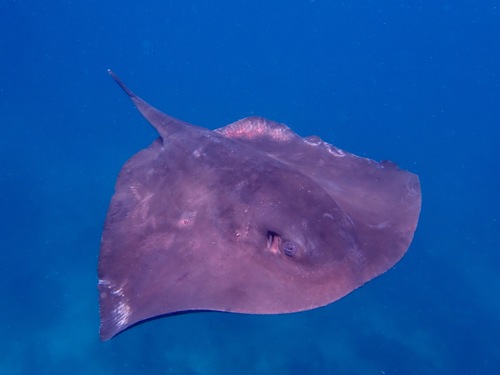
The pelagic stingray (Pteroplatytrygon violacea) is a species of stingray in the family Dasyatidae, and the sole member of its genus. It is characterized by the wedge-like shape of its pectoral fin disc, which is much wider than long, as well as by the pointed teeth in both sexes, whip-like tail with extremely long tail spine, and uniform violet to blue-green coloration. It generally reaches 59 cm (23 in) in width. The pelagic stingray has a worldwide distribution in waters warmer than 19 °C (66 °F), and migrates seasonally to spend the summer closer to the continental shelf and at higher latitudes. The only stingray that almost exclusively inhabits the open ocean, this species is typically found in surface waters down to a depth of 100 m (330 ft). As a consequence of its midwater habits, its swimming style has evolved to feature more of a flapping motion of the pectoral fins, as opposed to the disc margin undulations used by other, bottom-dwelling stingrays.

Appearance

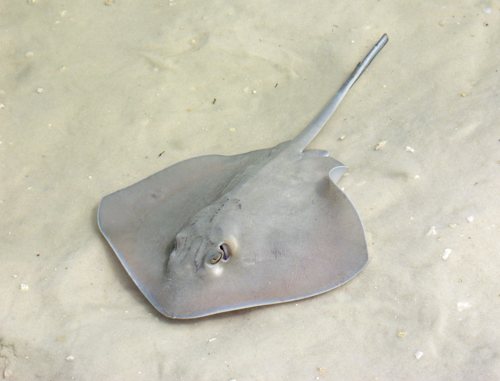
The pelagic stingray has a very thick, distinctively wedge-shaped pectoral fin disc one-third wider than long, with broadly curved leading margins, rather angular outer corners, and nearly straight trailing margins. The snout is short with a rounded tip. The eyes are minute and, unlike in other stingrays, do not protrude above the body; the spiracles (paired respiratory openings) follow immediate behind. There is a short but broad curtain of skin between the nostrils, with a weakly fringed rear margin. The mouth is small and gently arched, with deep furrows at the corners and a tiny projection at the center of the upper jaw that fits into an indentation on the lower jaw. There are anywhere from 0 to 15 forked papillae (nipple-like structures) in a row across the floor of the mouth.
Habitat

The distribution of the pelagic stingray extends nearly worldwide in tropical to warm-temperate pelagic waters, between the latitudes of 52°N and 50°S. In the western Atlantic, it has been reported from the Grand Banks of Newfoundland to North Carolina, the northern Gulf of Mexico, and the Lesser Antilles, Brazil and Uruguay. In the eastern Atlantic, this species has been recorded from the North Sea to Madeira, including the Mediterranean, as well as around Cape Verde, in the Gulf of Guinea and off South Africa. In the Pacific, it is known from Japan to Australia and New Zealand in the west, British Columbia to Chile in the east, and around many oceanic islands including Hawaii, the Galápagos, and Easter Island. There have been no reports of this species from much of the Indian Ocean, but it is known to be common in the southwestern portion and around Indonesia.

Diet

The pelagic stingray is an active predator that captures prey by wrapping its pectoral fins around it, before manipulating it to the mouth. It is the only stingray in which both sexes have pointed teeth, for grasping and cutting into slippery prey. A wide variety of organisms are represented in its diet: crustaceans including amphipods, krill, and larval crabs, molluscs including squid, octopus, and pteropods, bony fishes including herring, mackerel, sea horses and filefish, comb jellies and medusae, and polychaete worms. Off California, pelagic stingrays hunt large mating aggregations of squid that form from November to April. Off Brazil, this species follows groups of Atlantic cutlassfish (Trichiurus lepturus) towards the coast in January and February, with both predators seeking small schooling fishes.

Behaviour

In adopting a midwater lifestyle, the pelagic stingray exhibits several characteristics different from those of its bottom-dwelling relatives. While most stingrays propel themselves by undulating their disc margins, this species swims by oscillating (flapping) its pectoral fins in a manner approaching the "underwater flying" employed by eagle rays. Oscillatory fin motions generate lift, thus improving cruising efficiency in open water at a cost to maneuverability. The pelagic stingray is adept at swimming backwards, which may compensate for the lower fine control offered by its swimming mode.

Humans & conservation

The pelagic stingray is not aggressive and rarely encountered because of its habitat preferences, but its very long tail spine demands extreme caution be exercised in handling it. It has been responsible for two known fatalities: a worker on a tuna longliner who was impaled by a captured ray, and another fishery worker who succumbed to tetanus days after being stung. This species has been kept in public aquariums for almost a century.

Part of

Where to see it

No dive sites list Pelagic Stingray yet. Explore the map to find sites near you.