
← All marine life
Pearl Stingray
Species IUCN · Near Threatened (NT)

Pearl Stingray

Fontitrygon margaritella, (Compagno & Roberts, 1984)

marinebrackish

About Pearl Stingray

The pearl stingray (Fontitrygon margaritella) is a little-known species of stingray in the family Dasyatidae, found in shallow coastal waters from Mauritania to Angola, though fossils have been found in Portugal. Growing to 30 cm (12 in) across, this species has a rounded pectoral fin disc with a pointed snout, and a wide band of dermal denticles over the back in adults. It closely resembles and is often confused for the much larger daisy stingray (F. margarita); both species are characterized by the presence of an enlarged, nacreous denticle in the middle of the back called a "pearl spine". The International Union for Conservation of Nature (IUCN) assesses the pearl stingray's conservation status as Near Threatened, but it is likely that most of the historically reported fishery catches of the daisy stingray were in fact of this species.

Appearance

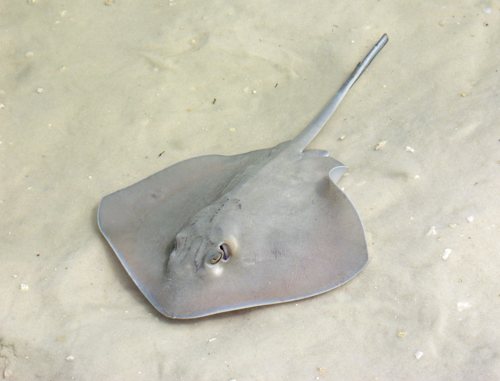
The pearl stingray has a moderately thin, oval-shaped pectoral fin disc about as long as wide. The narrow snout tapers to a point that protrudes somewhat from the disc. The eyes are immediately followed by the spiracles, which are of approximately equal size. There is a flap of skin between the nares with a weakly curved or lobed, fringed posterior margin; a pair of grooves run between this flap and the corners of the gently bow-shaped mouth. There are five papillae in a row across the floor of the mouth. There are 24–41 upper tooth rows and 34–50 lower tooth rows. The blunt, ridged teeth are arranged into pavements with a quincunx pattern; those of adult males are longer than those of females, but are not pointed. The pelvic fins are short and triangular with their tips projecting slightly beyond the disc margin.
Habitat

The pearl stingray is found along the western coast of Africa, from Cape Blanc in Mauritania to Angola. This bottom-dwelling species inhabits shallow, coastal marine and brackish waters, and has been reported from lagoons and estuaries, including the mouth of the Congo River.

Behaviour

Little is known of the natural history of the pearl stingray. Like other stingrays, it is aplacental viviparous with females likely bearing litters of 1–3 pups. Sexual maturation occurs at a disc width of around 20 cm (7.9 in).

Humans & conservation

Despite its small size, the pearl stingray is probably taken by "catch-all" commercial fisheries operating in coastal waters off Senegal, Ghana, Côte d'Ivoire, and elsewhere, using longlines, bottom trawls, and trammel nets. However, no specific utilization data is available as it was and continues to be combined with the daisy stingray in catch records. The International Union for Conservation of Nature (IUCN) has listed this species as Near Threatened. Given that the pearl stingray was once (and may still be) much more abundant than the daisy stingray, it likely comprised a majority of historically reported "daisy stingray" catches.

Part of

Where to see it

No dive sites list Pearl Stingray yet. Explore the map to find sites near you.