← All marine life
Peacock Hind
Species IUCN · Least Concern (LC)

Peacock Hind

Cephalopholis argus, Schneider, 1801

marine

About Peacock Hind

Cephalopholis argus, the peacock hind, roi, bluespotted grouper, and celestial grouper, is a species of marine ray-finned fish, a member of the subfamily Epinephelinae, the groupers, and part of the family Serranidae, which also includes the anthias and sea basses. They come from the Indo-Pacific and are variously a commercial gamefish, an invasive species, and occasionally an aquarium resident. Its species name comes from its resemblance to the "hundred staring eyes" of the monster Argus who had a hundred eyes and was the shepherd of the goddess Hera in Greek mythology.

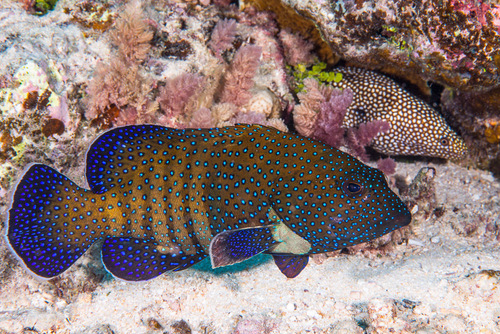
Appearance

This is a medium-sized fish that can reach a length of 60 centimeters (24 in). Small individuals are dark brown with hundreds of small, dark-edged iridescent blue spots. Larger specimens sometimes develop four to six lighter vertical bars on the back half of its body.

Habitat

The species is extremely widely distributed, occurring in warm waters from the Red Sea to South Africa and east to French Polynesia and the Pitcairn group. It is also present in northern Australia, Lord Howe Island, and Japan, and has been introduced to the Hawaiian Islands. It makes use of a variety of habitats but prefers the exposed fronts of reefs, at depths of up to 40 m.

Diet

Analysis of stomach contents of Hawaiian roi found that diets consist of 97.7% fish and 2.3% crustaceans. Of the fish eaten, there were 27.1% Scaridae (Parrotfish), 18.7% Acanthuridae (Surgeonfish), 17.6% Squirrelfish, 13.7% Monacanthidae (Filefish), 9.3% Priacanthidae (Bigeyes), 4.3% Chaetodontidae (Butterflyfish), 2.8% Aulostomidae (Trumpetfishes), and 6.9% other consisting of 9 families. Roi are estimated to eat 0.8% of their body weight each day.

Behaviour

Hunting, they lie on the bottom and surge forward, preferring juvenile surgeonfish and crustaceans. Alternatively they may hover motionless in the water column before attacking.

This grouper may follow and cooperate with another predator species, such as an octopus or eel or camouflage themselves in a school of surgeonfish. Multiple individuals may cooperate to harass an eel to get it to flush prey for them.

In the Red Sea, they hunt in the morning and evening.

Reproduction

In Micronesia, spawning usually occurs territorially at dusk. During courtship, both sexes darken except for a white keyhole-shaped patch at the center of the body.

Humans & conservation

The peacock hind is an invasive species in Hawaii. Known in Hawaii as roi, the state introduced the species in the 1950s to enhance local fisheries. Hawaii's Division of Aquatic Resources (DAR) finds that roi have become the reefs' dominant predator. The Roi population there has increased 15 fold since the 1980s. From 1999 to 2005 there was a 23% increase in their population. Their biomass is now greater than that of all other reef fish predators combined.

These predators threaten native reef fish such as parrotfish and goatfish. A University of Hawaii study estimated that in a three-square-mile area off the Kona Coast of Hawaii Island, Roi eat 90 tonnes (89 long tons; 99 short tons) of reef fish annually— equivalent to 8.2 million fish.

Part of

Where to see it

No dive sites list Peacock Hind yet. Explore the map to find sites near you.