Appearance
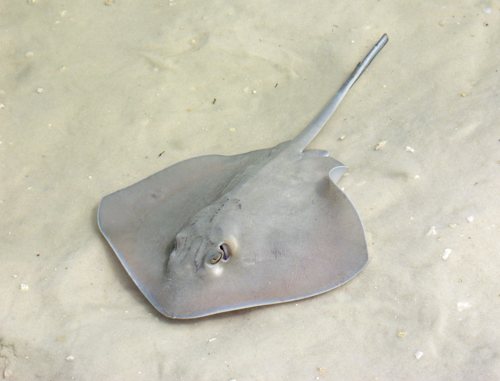
This species can be distinguished from its closest congener (Neotrygon kuhlii) through several characteristics, such as abruptly angular pectoral apices, dusky ventral tail fold with darker edge, small mouth, pronounced mask-like markings, and covered with moderate-sized blue spots and dark peppery spots. The maximum size for the male specimens is 38 cm disc width (DW).It is often confused with the newly described Neotrygon yakkoei and the Neotrygon khulli complex. The high morphological similarities among the species make species of the Khulli complex hard to identify. Phylogenetically, N. orientalis and N. varidens form a sister clade to the species N. indica, which may have a common ancestor in the Plio-Pleistocene.