
← All marine life
Olive Ridley Sea Turtle
Species IUCN · Vulnerable (VU)

Olive Ridley Sea Turtle

Lepidochelys olivacea, (Eschscholtz, 1829)

marine

About Olive Ridley Sea Turtle

The olive ridley sea turtle (Lepidochelys olivacea), also known commonly as the Pacific ridley sea turtle, is a species of turtle in the family Cheloniidae. The species is the second-smallest and most abundant of all sea turtles found in the world. L. olivacea is found in warm and tropical waters, primarily in the Pacific and Indian Oceans, but also in the warm waters of the Atlantic Ocean.

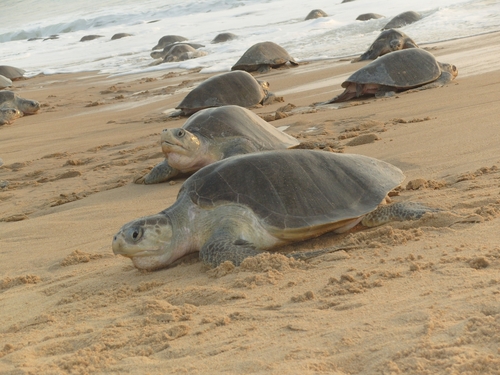
This turtle and the related Kemp's ridley sea turtle are best known for their unique synchronised mass nestings called arribadas, where thousands of females come together on the same beach to lay eggs.

Appearance

Growing to about 61 cm (2 ft) in carapace length (measured along the curve), the olive ridley sea turtle gets its common name from its olive-colored carapace, which is heart-shaped and rounded. Males and females grow to the same size, but females have a slightly more rounded carapace as compared to males. The heart-shaped carapace is characterized by four pairs of pore-bearing inframarginal scutes on the bridge, two pairs of prefrontals, and up to nine lateral scutes per side. L. olivacea is unique in that it can have variable and asymmetrical lateral scute counts, ranging from five to nine plates on each side, with six to eight being most commonly observed. Each side of the carapace has 12–14 marginal scutes.
Habitat

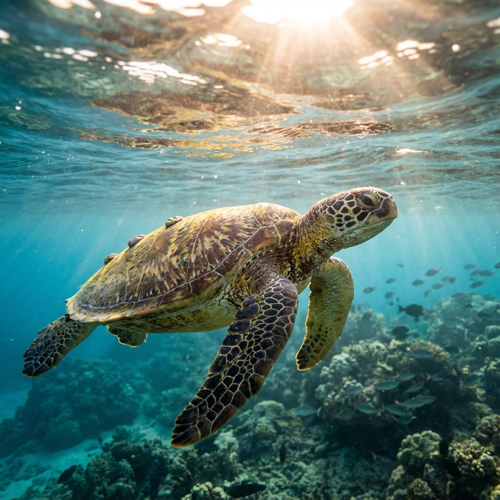
The olive ridley turtle has a circumtropical distribution, living in tropical and warm waters of the Pacific and Indian Oceans from India, Arabia, Japan, and Micronesia south to southern Africa, Australia, and New Zealand. In the Atlantic Ocean, it has been observed off the western coast of Africa and the coasts of northern Brazil, Suriname, Guyana, French Guiana, and Venezuela. Additionally, the olive ridley has been recorded in the Caribbean Sea as far north as Puerto Rico. A female was found alive on an Irish Sea beach on the Isle of Anglesey, Wales, in November 2016, giving this species its northernmost appearance. It was taken in by the nearby Anglesey Sea Zoo, while its health was assessed. A juvenile female was found off the coast of Sussex in 2020.

Diet

The olive ridley is predominantly carnivorous. Common prey items include tunicates (salps and sea squirts), starfish, sea urchins, bryozoans, squid, bivalves, snails, barnacles, shrimp, crabs, rock lobsters, and sipunculid worms. Additionally, consumption of jellyfish and both adult fish (e.g. Sphoeroides) and fish eggs may be indicative of pelagic (open ocean) feeding. The olive ridley is also known to feed on filamentous algae in areas devoid of other food sources. Captive studies have indicated some level of cannibalistic behavior in this species.

Behaviour

Mating is often assumed to occur in the vicinity of nesting beaches, but copulating pairs have been reported over 1,000 km from the nearest beach. Research from Costa Rica revealed the number of copulating pairs observed near the beach could not be responsible for the fertilization of the tens of thousands of gravid females, so a significant amount of mating is believed to have occurred elsewhere at other times of the year.

Humans & conservation

Known predators of olive ridley eggs include raccoons, coyotes, feral dogs and pigs, opossums, coatimundi, caimans (Caiman, Paleosuchus), ghost crabs, and the sunbeam snake. Hatchlings are preyed upon as they travel across the beach to the water by vultures (Cathartes, Coragyps atratus), frigate birds, crabs (Gecarcinus, Ocypode), raccoons, coyotes, iguanas, and snakes. In the water, hatchling predators most likely include oceanic fishes, sharks, and crocodiles. Adults have relatively few known predators, other than tiger sharks and crocodiles, and killer whales are responsible for occasional attacks. On land, nesting females may be attacked by jaguars. Notably, the jaguar is the only cat with a strong enough bite to penetrate a sea turtle's shell, thought to be an evolutionary adaption from the Holocene extinction event.

Part of

Where to see it

No dive sites list Olive Ridley Sea Turtle yet. Explore the map to find sites near you.