
← All marine life
Norway Lobster
Species IUCN · Least Concern (LC)

Norway Lobster

Nephrops norvegicus, (Linnaeus, 1758)

marine

About Norway Lobster

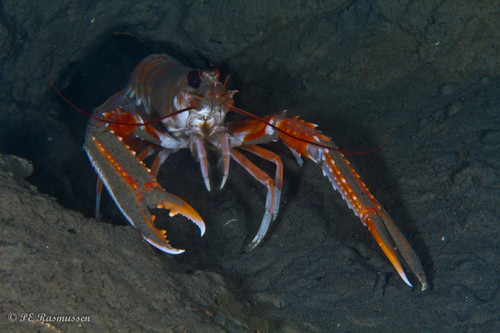
Nephrops norvegicus, known variously as the Norway lobster, Dublin Bay prawn, langoustine (compare langostino) or scampi, is a slim, coral-colored lobster that grows up to 25 cm (10 in) long. It is now the only extant species in the genus Nephrops, after several other species were moved to the closely related genus Metanephrops. It lives in the north-eastern Atlantic Ocean, and parts of the Mediterranean Sea, but is absent from the Baltic Sea and Black Sea. Adults emerge from their burrows at night to feed on worms and fish.

Appearance

Nephrops norvegicus has the typical body shape of a lobster, albeit narrower than the larger-bodied genus Homarus. It is pale orange in colour, and grows to a typical length of 18–20 centimetres (7–8 in), or exceptionally 25 cm (10 in) long, including the tail and claws. A carapace covers the animal's cephalothorax, while the abdomen is long and segmented, ending in a broad tail fan. The first three pairs of legs bear claws, of which the first are greatly elongated and bear ridges of spines. Of the two pairs of antennae, the second is the longer and thinner. There is a long, spinous rostrum, and the compound eyes are kidney-shaped, providing the name of the genus, from the Greek roots νεφρός (nephros, "kidney") and ὄψ ("eye").
Habitat

Nephrops norvegicus is found in the north-eastern Atlantic Ocean and North Sea as far north as Iceland and northern Norway, and south to Portugal. It is found in the Mediterranean Sea and is common in the Adriatic Sea, notably the north Adriatic. It is absent from both the Black Sea and the Baltic Sea. Due to its ecological demands for particular sediments, N. norvegicus has a very patchy distribution, and is divided into over 30 populations. These populations are separated by inhospitable terrain, and adults rarely travel distances greater than a few hundred metres.

Diet

Nephrops norvegicus is a scavenger and predator that makes short foraging excursions, mainly during periods of subdued light. They feed on active prey, including worms and fish, which they capture with their chelipeds and walking legs, and food is conveyed to the mouth using the anterior walking legs, assisted by the maxillipeds.

There is evidence that Nephrops norvegicus is a major eater of jellyfish.

Behaviour

Nephrops norvegicus adults prefer to inhabit muddy seabed sediments, with more than 40 percent silt and clay. Their burrows are semi-permanent, and vary in structure and size. Typical burrows are 20 to 30 centimetres (8 to 12 in) deep, with a distance of 50 to 80 centimetres (20 to 30 in) between the front and back entrances. Norway lobsters spend most of their time either lying in their burrows or by the entrance, leaving their shelters only to forage or mate.

Reproduction

The typical life span of N. norvegicus is 5–10 years, reaching 15 years in exceptional cases. Its reproductive cycle varies depending on geographical position: "the periods of hatching and spawning, and the length of the incubation period, vary with latitude and the breeding cycle changes from annual to biennial as one moves from south to north". Incubation of eggs is temperature-dependent, and in colder climates, the duration of the incubation period increases. This means that, by the time hatching occurs, it may be too late for the females to take part in that year's breeding cycle. In warmer climates, the combined effects of recovery from moulting and ovary maturation mean that spawning can become delayed. This, in turn, has the effect of the female missing out a year of egg carrying.

Humans & conservation

Commercial fishing for N. norvegicus has developed rapidly starting in the 1960s and is now one of the "most economically important fisheries in Europe", about 58% in the UK, 12% in Ireland, and 7% in the Mediterranean (Italy, Spain, Greece). This is a recent phenomenon: "unlike 50 years ago [1960s], [it] is now regarded as a delicious shellfish by chefs and consumers throughout Europe". N. norvegicus has been known in the Mediterranean longer, but until recently, "British fishermen dumped langoustines they caught as they were deemed not worth the effort".

Part of

Where to see it

No dive sites list Norway Lobster yet. Explore the map to find sites near you.