
← All marine life
Northern Rockhopper Penguin
Species IUCN · Endangered (EN)

Northern Rockhopper Penguin

Eudyptes moseleyi, Mathews & Iredale, 1921

marine

About Northern Rockhopper Penguin

The northern rockhopper penguin (Eudyptes moseleyi), also known as Moseley's rockhopper penguin, Moseley's penguin, or Tristan penguin, is a penguin species native to the southern Indian and Atlantic Oceans. It was formerly considered conspecific with the eastern and western rockhopper penguins.

A study published in 2009 showed that the population of the northern rockhopper had declined by 90% since the 1950s. For this reason, the northern rockhopper penguin is classified as endangered.

Appearance

The rockhopper penguin (Eudyptes chrysocome) was split into three distinct subspecies in 1992; the southern, (E. c. chrysocome), eastern (E. c. filholi) and northern rockhopper penguin (E. c. moseleyi). The three subspecies are distinguished by differences in the length of the tassels of the crests, the size and colour of the fleshy margin of the gape, colour pattern on the underside of the flipper and differences in the size of the superciliary stripe in front of the eye. Additionally, the northern rockhopper penguin is larger than the other two subspecies. Proof that the three subspecies were truly different, in terms of more than reproductive isolation and some morphological features, was found in the mitochondrial sequences of the three species. It was found E. c. filholi and E. c. chrysocome were not as different genetically as E. c. moseleyi was to the other two subspecies.
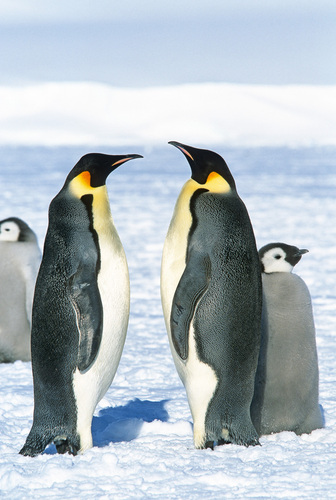
Habitat

More than 99% of northern rockhoppers breed during late spring or early summer on Tristan da Cunha and Gough Island in the south Atlantic Ocean. Breeding colonies are also found on the French Southern and Antarctic Lands of Amsterdam Island and St Paul Island.

It is very rare for the bird to make landfall on the Australian continent, but in 2006, a northern rockhopper was sighted at Robe, South Australia, and in July 2023 a very underweight northern rockhopper was found at Goolwa beach in South Australia.

Behaviour

The northern rockhopper penguin feeds on krill and other sea life such as crustaceans, squid, octopus and fish.

Reproduction

It breeds in colonies in a range of locations from sea level or on cliff sides, to sometimes inland. The Northern form, found in Amsterdam and Gough island, is reproductively isolated from the Crozet and Kerguelen islands. They are monophyletic; meaning they have a split in the mitochondria DNA trees which forms two subspecies: the northern and southern rockhopper penguin. Another interesting difference between the two subspecies is their mating ritual. They both use different songs and head ornaments in their mating signals. The reproductive isolation has led to not only physical difference but also behavioral. The adults feed their chicks lower trophic level prey than they themselves consume. During breeding season the adults eat zooplankton and then transition to fish, showing they favor future reproduction.

Humans & conservation

The current population is estimated to be between 100,000–499,999 breeding pairs at Gough Island, 18,000 to 27,000 pairs at Inaccessible Island, and 3,200 to 4,500 at Tristan da Cunha. In the Indian Ocean, the population was 25,500 pairs on Amsterdam Island, and 9,000 pairs on St Paul Island in 1993; there has been no information available on population trends there since the 1990s. Atlantic Ocean sites show a decline of 2.7% per year; the drop in the population at Gough Island has been described as equivalent to the loss of 100 birds every day since the 1950s.

Part of

Where to see it

No dive sites list Northern Rockhopper Penguin yet. Explore the map to find sites near you.