
← All marine life
Northern Right Whale Dolphin
Species IUCN · Least Concern (LC)

Northern Right Whale Dolphin

Lissodelphis borealis, (Peale, 1848)

marine

About Northern Right Whale Dolphin

The northern right whale dolphin (Lissodelphis borealis) is a small, slender species of cetacean found in the cold and temperate waters of the North Pacific Ocean. Lacking a dorsal fin, and appearing superficially porpoise-like, it is one of the two species of right whale dolphin.

Appearance

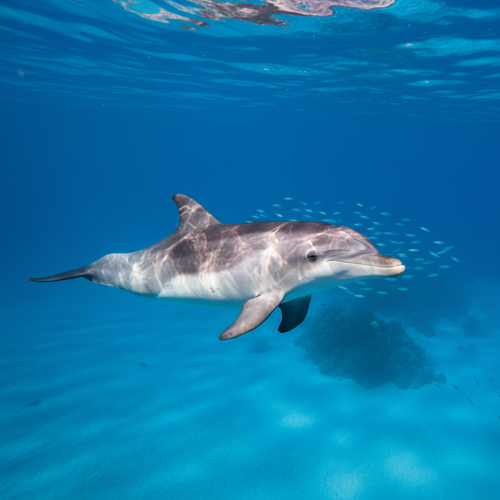
The northern right whale dolphin has a streamlined body with a sloping forehead, and a slimmer build than other delphinids. It lacks any fin or ridge on the smoothly curving back. Its body is nearly all-black with a white ventral marking, extending forward as a narrow band from the caudal peduncle to the throat region, where the patch widens. In females, this white band is wider in the genital area than in males. In southern right whale dolphins (Lissodelphis peronii), the white patch extends higher on the posterior flanks and head. Calves, which are born initially creamy-dark grey or brown, attain adult colouring by the age of one year.

The beak of northern right whale dolphins is short and well-defined, characterised by a straight mouthline. The flippers are small, curved, narrow and pointed. The tail flukes are triangular and, like the flippers, rather pointed.
Habitat

Northern right whale dolphins are found in cold to temperate waters, 8 to 24 °C (46 to 75 °F), of the North Pacific Ocean. They typically inhabit offshore, oceanic regions between 34°N to 55°N and 145°W to 118°E. However, L. borealis has been reported as far south as 29° N, off Baja California (Mexico), during times of anomalously cold water temperatures. Off the US west coast, northern right whale dolphins have been seen primarily in shelf and slope waters.

Migration patterns of northern right whale dolphins are not well understood, but aerial surveys off the US coast suggest seasonal changes in density that may reflect seasonal movements. Overall, distributions appear to shift northward in summer and southward in winter. However, contradicting patterns have also been observed.

Behaviour

Northern right whale dolphins are fast swimmers. Their average swimming speed is around 26 km/h (16 mph) but they can reach speeds of up to 30–40 km/h (19–25 mph). When travelling fast, a group looks as though they are bouncing along on the water, as they make low, graceful leaps together, sometimes travelling as far as 7 m in one leap. They can dive up to 200 m (660 ft) deep in search of squid and fish, especially lanternfish. Additionally, L. borealis also feeds on other prey items, such as Pacific hake, saury and mesopelagic fish.

Although northern right whale dolphins rarely approach boats, they sometimes engage in bow-riding behaviour. Furthermore, they are occasionally spotted doing acrobatics, such as breaching, belly-flopping, side slapping, and lobtailing.

Humans & conservation

It is estimated that a total of around 68,000 northern right whale dolphins inhabit the Pacific Ocean. Of those, around 26,000 (the geometric mean of their abundance estimates in US waters during 2008–2014) are placed into the California/ Oregon/ Washington stock for management purposes. Their minimum population estimate is around 18,600. Their abundances and distributions along the US coast do not only vary seasonally but also interanually, making the identification of population trends difficult.

Part of

Where to see it

No dive sites list Northern Right Whale Dolphin yet. Explore the map to find sites near you.