
← All marine life
Northern Fur Seal
Species IUCN · Vulnerable (VU)

Northern Fur Seal

Callorhinus ursinus, (Linnaeus, 1758)

marine

About Northern Fur Seal

The northern fur seal (Callorhinus ursinus) is an eared seal found along the north Pacific Ocean, the Bering Sea, Sea of Japan and the Sea of Okhotsk. It is the largest member of the fur seal subfamily (Arctocephalinae) and the only living species in the genus Callorhinus. A single fossil species, Callorhinus gilmorei, is known from the mid-late Pliocene of California, Mexico, and Japan.

Appearance

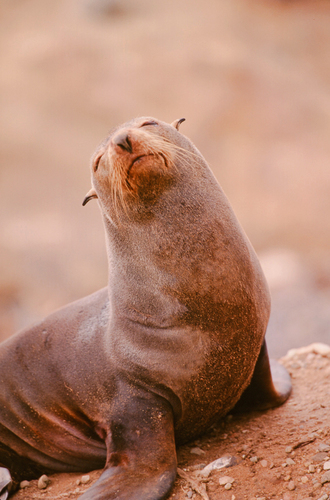
Northern fur seals exhibit sexual dimorphism, with males being about a third longer and more than 4.5 times heavier than adult females. Both sexes have short, down-curved muzzles and a small nose in which extends slightly beyond the mouth in females and a bit more in males. The lush pelage is thick with a dense, cream-colored underfur. This underfur is covered with longer guard hairs that can be seen when the fur is wet and their flippers are unique of the species. Due to the cartilaginous extensions on all of the toes, the fur seal species has the longest hind flippers in any otariid . The ear pinnae are long and in older individuals, lose the dark fur on the tips . Young pups are born with a black pelt, gaining colors of darker brown across the body and lighter coloration on the chest and belly. Adult males also have gray hair on the back of their necks in contrast to females.
Habitat

The northern fur seal is found in the north Pacific – its southernmost reach is a line that runs roughly from the southern tip of Japan to the southern tip of the Baja California Peninsula, the Sea of Okhotsk, and the Bering Sea. An estimated 1.1 million northern fur seals occur across the range, of which roughly half breed on the Pribilof Islands in the east Bering Sea. Another 200–250 thousand breed on the Commander Islands in the west Bering Sea, some 100,000 breed on Tyuleniy Island off the coast of Sakhalin in the southwest Sea of Okhotsk, and another 60–70 thousand in the central Kuril Islands in Russia. Smaller rookeries (around 5,000 animals) are found on Bogoslof Island in the Aleutian Chain, San Miguel Island in the Channel Island group and South Farallon Island off the coast of California.

Behaviour

This species is considered a generalist that takes on a varying diet dependent on location and season from midwater fish to squid. In Alaskan waters and the Bering Sea shelf, walleye pollock, capelin, and several species of squid are consumed most . When entering the West Coast, mackerel, octopus, sardine and more become staples in the diet. Colony-specific areas are targetted for foraging opportunities with other preferred land sites used for resting and reproduction/raising their young .

Northern fur seals are preyed upon primarily by sharks and killer whales . Occasionally, very young animals are eaten by Steller sea lions .

Reproduction

Seals enter breeding rookeries in May. Generally, older males (10 years and older) return first and compete for prime breeding spots on the rookeries. They remain on the rookery, fasting throughout the duration of the breeding season . The females come somewhat later, and give birth shortly thereafter. Like all other otariids, northern fur seals are polygynous, with some males breeding with up to 50 females in a single breeding season. Unlike Steller sea lions, with which they share habitat and some breeding sites, northern fur seals are possessive of individual females in their harem, often aggressively competing with neighboring males for females . Deaths of females as a consequence of these conflicts have been recorded, though the males themselves are rarely seriously injured .

Humans & conservation

Concern about the status of fur seal populations has increased, particularly in the Pribilof Islands, where pup production has decreased about 50% since the 1970s, with a continuing drop of about 3.4% per year through 2018 . This has caused them to be listed as "vulnerable" on the IUCN Red List, and more specifically, the Pribilof Islands / eastern Pacific stock is listed as "depleted" under the U.S. Marine Mammal Protection Act, though to date the species is not yet listed under the U.S. Endangered Species Act). Increasing concern about the species' status, particularly in the eastern part of its range, has led to an intensified research program into their behavioral and foraging ecology with an estimated decline 1.8% annually from 1999-2019.

Part of

Where to see it

No dive sites list Northern Fur Seal yet. Explore the map to find sites near you.