
← All marine life
Northern Elephant Seal
Species IUCN · Least Concern (LC)

Northern Elephant Seal

Mirounga angustirostris, (Gill, 1866)

marine

About Northern Elephant Seal

The northern elephant seal (Mirounga angustirostris) or northern sea elephant, is one of two species of elephant seal (the other is the southern elephant seal). It is a member of the family Phocidae (true seals). Elephant seals derive their name from their great size and from the male's large proboscis. Sexual dimorphism in size is great. Correspondingly, the mating system is highly polygynous; a successful male is able to impregnate up to 50 females in one season.

Appearance

The huge male northern elephant seal typically weighs 1,500–2,300 kg (3,300–5,100 lb) and measures 4–5 m (13–16 ft), although some males can weigh up to 3,700 kg (8,200 lb). Females are much smaller and can range from 400 to 900 kg (880 to 1,980 lb) in weight, or roughly a third of the male's bulk, and measure from 2.5 to 3.6 m (8.2 to 11.8 ft). The bull southern elephant seals are, on average, larger than those in the northern species, but the females in both are around the same size, indicating the even higher level of sexual dimorphism in the southern species. Although a few females have been observed to reach 23 years of age and a few males to reach 14, most die much younger.
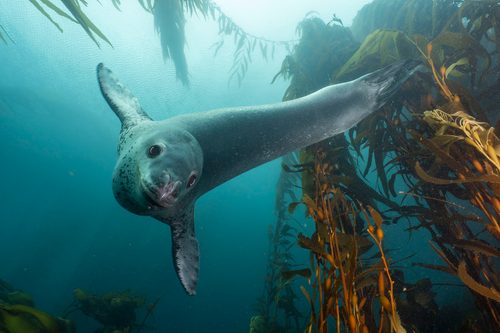
Habitat

The northern elephant seal lives in the eastern Pacific Ocean. They spend most of their time at sea, and usually only come to land to give birth, breed, and molt. These activities occur at rookeries that are located on offshore islands or remote mainland beaches. The majority of these rookeries are in California and northern Baja California, ranging from Point Reyes National Seashore, California to Isla Natividad, Mexico. Significant breeding colonies exist at Channel Islands, Año Nuevo State Reserve, Piedras Blancas Light, and the Farallon Islands in the US, and Isla Guadalupe, Isla Benito del Este and Isla Cedros in Mexico. In recent decades the breeding range has extended northwards. In 1976 the first pup was found on Point Reyes and a breeding colony established there in 1981.

Behaviour

Northern elephant seals return to their terrestrial breeding ground in December and January, with the bulls arriving first. The bulls haul out on isolated or otherwise protected beaches, typically on islands or very remote mainland locations. It is important that these beach areas offer protection from the winter storms and high surf wave action. The bulls engage in fights of supremacy to determine which few bulls will achieve a harem.

Humans & conservation

Beginning in the 18th century, northern elephant seals were hunted extensively, almost to extinction by the end of the 19th century, being prized for oil made from their blubber, and the population may have fallen as low as only 20–40 individuals. In 1874, Charles Melville Scammon recorded in Marine Mammals of the Northwestern Coast of America, that an 18-foot (5.5 m) long bull caught on Santa Barbara Island yielded 210 US gallons (795 L; 175 imp gal) of oil. They were thought to be extinct in 1884 until a remnant population of eight individuals was discovered on Guadalupe Island in 1892 by a Smithsonian expedition, who promptly killed several for their collections. The elephant seals managed to survive, and were finally protected by the Mexican government in 1922. Since the early 20th century, they have been protected by law in both Mexico and in the United States.

Part of

Where to see it

No dive sites list Northern Elephant Seal yet. Explore the map to find sites near you.