
← All marine life
North American River Otter
Species IUCN · Least Concern (LC)

North American River Otter

Lontra canadensis, (Schreber, 1777)

marinebrackishfreshwater

About North American River Otter

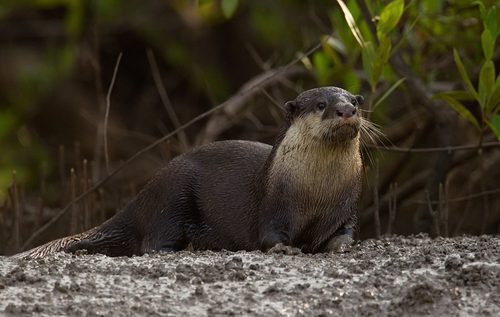
The North American river otter (Lontra canadensis), also known as the northern river otter and river otter, is a semiaquatic mammal that is endemic to the North American continent throughout most of Canada and along the coasts of the United States and its inland waterways. An adult North American river otter can weigh between 5 and 14 kilograms (11–31 lb). The river otter is protected and insulated by a thick, water-repellent coat of fur.

The North American river otter, a member of the subfamily Lutrinae in the weasel family (Mustelidae), is equally versatile in the water and on land. It establishes a burrow close to the water's edge in river, lake, swamp, coastal shoreline, tidal flat, or estuary ecosystems. The den typically has many tunnel openings, one of which generally allows the otter to enter and exit the body of water. Females give birth in these burrows, producing litters of one to six young.

North American river otters, like most predators, prey upon the most readily accessible species. Fish is a favored food among the otters, but they also consume various amphibians (such as salamanders and frogs), freshwater clams, mussels, snails, small turtles, and crayfish. The most common fish consumed are perch, suckers, and catfish. Occasional reports also show the river otter eating other small animals, such as mice, squirrels, birds, and even dogs that they have attacked and drowned.

Appearance

The North American river otter has long and thin whiskers that are used to detect prey in dark waters. An average adult male weighs about 11.3 kilograms (25 lb) against the female's average of 8.3 kg (18 lb). Its body length ranges from 66 to 107 cm (26–42 in). About one-third of the animal's total length consists of a long, tapered tail. Tail lengths range from 30 to 50 cm (12–20 in). Large males can exceed a weight of 15 kg (33 lb). It differs from the Eurasian otter by its longer neck, narrower visage, the smaller space between the ears, and shorter tail.

Males and female river otters show different nonsexual physical characteristics, with males typically being larger.

North American river otters can live 21–25 years in captivity, or 8–13 years in the wild.
Habitat

The North American river otter is found throughout North America, inhabiting inland waterways and coastal areas in Canada, the Pacific Northwest, the Atlantic states, and states on the Gulf of Mexico. They also inhabit the forested regions near the Pacific coast in North America. The species is also present throughout Alaska, including the Aleutian Islands, and the north slope of the Brooks Range.

Diet

Aquatic predators of the North American river otter include the American alligator (Alligator mississippiensis), American crocodile (Crocodylus acutus), and killer whale (Orcinus orca), none of which commonly coexist with the North American river otter and thus rarely pose a threat. Terrestrial predators include the bobcat (Lynx rufus), cougar (Puma concolor), coyote (Canis latrans), domestic dog (Canis familiaris), wolf (Canis lupus), American black bear (Ursus americanus), bald eagle (Haliaeetus leucocephalus), and red fox (Vulpes vulpes), grizzly bears (Ursus arctos horribilis) and polar bears (Ursus maritimus)

Behaviour

North American river otters only settle in areas that consist of vegetation, rock piles, and sufficient coverage.

Reproduction

Delayed implantation distinguishes the species from the Eurasian otter, which does not do this.

In early spring, expectant mothers begin to look for a den where they can give birth. The female otters do not dig their own dens; instead, they rely on other animals, such as beavers, to provide suitable environments to raise their offspring. When the mothers have established their domains, they give birth to several kits. Litter size can reach five, but usually ranges from one to three. Each otter pup weighs approximately five ounces.

The mothers raise their young without aid from adult males. When the pups are about two months old and their coats grow in, their mother introduces them to the water. North American river otters are natural swimmers, and with parental supervision, they easily acquire the skills necessary to swim.

Humans & conservation

Threats to North American river otter populations in North America vary regionally. North American river otter inhabitation is affected by type, distribution, and density of aquatic habitats and characteristics of human activities. Preceding the settlement of North America by Europeans, North American river otters were prevalent among aquatic habitats throughout most of the continent. Trapping, loss or degradation of aquatic habitats through filling of wetlands, and development of coal, oil, gas, tanning, timber, and other industries, resulted in local extinctions or population declines in North American river otter populations in many areas. In 1980, an examination conducted on U.S. river otter populations determined they were locally extinct in 11 states, and lost significant population in 9 other states.

Part of

Where to see it

No dive sites list North American River Otter yet. Explore the map to find sites near you.