
← All marine life
Nomura's Jellyfish
Species

Nomura's Jellyfish

Nemopilema nomurai, Kishinouye, 1922

marine

About Nomura's Jellyfish

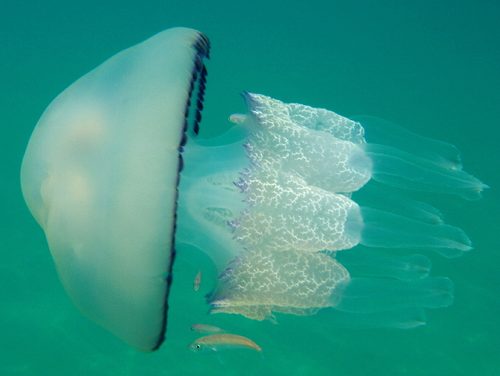
Nomura's jellyfish (エチゼンクラゲ, echizen kurage; Nemopilema nomurai) is a very large rhizostome jellyfish, in the same size class as the lion's mane jellyfish, the largest cnidarian in the world. It is edible but not considered high quality. It is the only species in the monotypic genus Nemopilema. Commonly found in the waters of East Asia, they can negatively affect fisheries due to their large size and quantity. As a form of combating the large blooms, recent studies attempt to find new uses for the large jellyfish such as studying its venom for medical applications.

Appearance

Nemopilema nomurai can grow up to 2 m (6 ft 7 in) in diameter and weigh up to 200 kg (440 lb), the diameter when fully grown is slightly greater than the height of an average human. The species was named in tribute to Mr. Kan'ichi Nomura (C18–C19), Director General of the Fukui Prefectural Fisheries Experimental Station, who in early December 1921 sent a specimen in a 72-litre (16 imp gal; 19 US gal) wooden tank to Professor Kishinouye, who found that it was unknown and dedicated time to study the living specimens.
Habitat

Nomura's jellyfish reside primarily in the waters between China and Japan, primarily centralized in the Yellow Sea and East China Sea. Population blooms appeared to be increasing with frequency in the time period of 1989–2009. Possible reasons for the population increase in Nomura's Jellyfish include climate change, overfishing, and coastal modification adding substrate for asexually producing polyps.

Diet

The Japanese company Tango Jersey Dairy produces a vanilla and jellyfish ice cream using Nomura's jellyfish. Consuming Echizen Kurage is potentially dangerous if the toxic part is not thoroughly cleaned and cooked.

Behaviour

This species of jellyfish feeds mostly on zooplankton in all stages of life, feeding on larger fish as they grow larger. Their only predators consist of swordfish, tuna, sunfish, leatherback turtles, and humans.

Reproduction

The life cycle of Nemopilema nomurai is very similar to that of other rhizostomes. Nomura's jellyfish are normally found in the Yellow Sea and populations are generally maintained there year round. During June and July, changes in the water salinity lead to the expatriation of larval stage jellyfish via the Tsushima strait. In 2005 the largest blooms were in late October. It is noted that this species of jellyfish in six months can grow from the size of a grain of rice to greater than 6 ft (1.8 m) wide.

Part of

Where to see it

No dive sites list Nomura's Jellyfish yet. Explore the map to find sites near you.