
← All marine life
New Zealand Sea Lion
Species IUCN · Endangered (EN)

New Zealand Sea Lion

Phocarctos hookeri, (Gray, 1844)

marine

About New Zealand Sea Lion

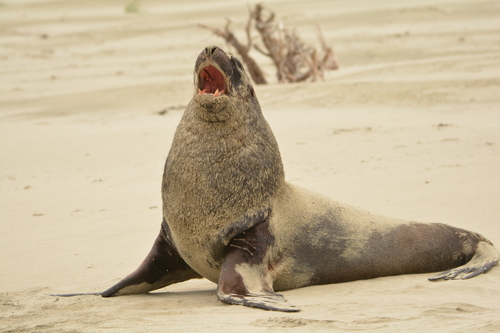
The New Zealand sea lion (Phocarctos hookeri), once known as Hooker's sea lion, and as pakake (for both male and female) or whakahao (male) and kake (female) in Māori, is a species of sea lion that is endemic to New Zealand and primarily breeds on New Zealand's subantarctic Auckland and Campbell islands, and have in recent years been slowly breeding and recolonising around the coast of New Zealand's South and Stewart islands. The New Zealand sea lion population estimate is less than 10,000 individuals and fewer than 5,000 breeding adults. This number has declined from an estimated population of over 15,000 in the early 2000s, and it is one of the world's rarest sea lion species. It is the only species of the genus Phocarctos.

Habitat

The main breeding populations are at the Auckland and Campbell Islands in the New Zealand subantarctic, where approximately 99% of the species' annual pup production occurs. There are currently three functioning breeding rookeries on the Auckland Islands. Most sea lions are born on Dundas Island. A smaller rookery exists at Sandy Bay on Enderby Island and the smallest rookery is on Figure of Eight Island. An even smaller rookery at South East Point on Auckland Island appears to now have been abandoned. The other major breeding area is the Campbell Islands.
Diet

New Zealand sea lions are known to prey on a wide range of species including fish such as Antarctic horsefish, red cod, opalfish and Patagonian toothfish, rays, sharks, cephalopods (e.g. New Zealand arrow squid and yellow octopus), crustaceans, seabirds and other marine mammals, and even New Zealand fur seals. Studies indicate a strong location effect on diet, with almost no overlap in prey species comparing sea lions at Otago Peninsula and Campbell Island, at the north and south extents of the species' breeding range. New Zealand sea lions are in turn preyed on by great white sharks, with 27% showing evidence of scarring from near-miss shark attacks in an opportunistic study of adult New Zealand sea lions at Sandy Bay, Enderby Island.

Behaviour

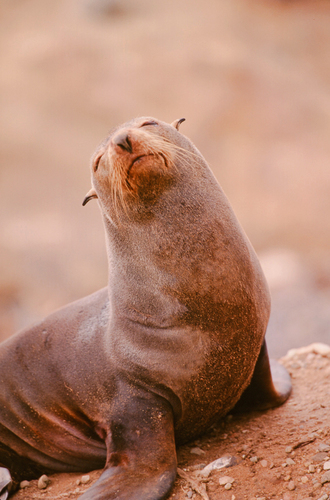
New Zealand sea lions are one of the largest New Zealand animals. Like all otariids, they have marked sexual dimorphism; adult males are 240–350 centimetres (7.9–11.5 ft) long and weigh 320–450 kilograms (710–990 lb), while adult females are 180–200 centimetres (5.9–6.6 ft) long and weigh 90–160 kilograms (200–350 lb). At birth, pups are 70–100 centimetres (2.3–3.3 ft) long and weigh 8–10 kilograms (18–22 lb); the natal pelage is a thick coat of dark brown hair that becomes dark grey with cream markings on the top of the head, nose, tail and at the base of the flippers. Adult females' coats vary from buff to creamy grey with darker pigmentation around the muzzle and the flippers. Adult males are blackish-brown with a well-developed black mane of coarse hair reaching the shoulders. New Zealand sea lions are strongly philopatric.

Humans & conservation

New Zealand sea lions are considered the most threatened sea lion in the world. The species' status is largely driven by the main breeding population at the Auckland Islands, which declined by ~50% between 2000 and 2015. The 2013 sea lion pup production count on the Auckland Islands showed the number of pups born on the islands has risen to 1931, from the 2012 figure of 1684 (dead pups are also counted, since the annual pup count is used to assess the population of breeding females, but not future births when the counted pups mature). The 2013 number was the highest in five years. The Campbell Island population 'appears to be increasing slowly' and births here comprise ~30% of the species' total. The Otago and Stewart Island sea lion populations are currently small, though increasing.

Part of

Where to see it

No dive sites list New Zealand Sea Lion yet. Explore the map to find sites near you.