
← All marine life
New Zealand Fur Seal
Species IUCN · Least Concern (LC)

New Zealand Fur Seal

Arctocephalus forsteri, (Lesson, 1828)

marine

About New Zealand Fur Seal

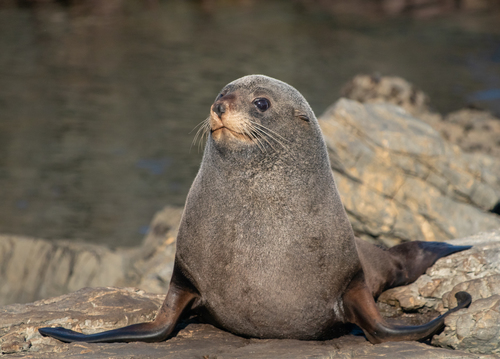
Arctocephalus forsteri (common names include the Australasian fur seal, South Australian fur seal, New Zealand fur seal, Antipodean fur seal, or long-nosed fur seal) is a species of fur seal found mainly around southern Australia and New Zealand. The name New Zealand fur seal is used by English speakers in New Zealand; kekeno is used in the Māori language. As of 2014, the common name long-nosed fur seal has been proposed for the population of seals inhabiting Australia.

Although the Australian and New Zealand populations show some genetic differences, their morphologies are very similar, and thus they remain classed as a single species. After the arrival of humans in New Zealand, and particularly after the arrival of Europeans in Australia and New Zealand, hunting reduced the population to near-extinction.

Appearance

Males have been reported as large as 160 kg (350 lb); their average weight is about 126 kg (278 lb). Males can be 2 m (6 ft 7 in) long. Females are between 30 and 50 kg (66–110 lbs) on average, and can be as long as 1.5 m (4 ft 11 in). Newborn pups are 3.3–3.9 kg (7.3–8.6 lbs) on average, and between 40 and 55 cm (1.3–1.8 ft) long. At 290 days old males are about 14.1 kg (31 lb), and females are about 12.6 kg (28 lb). Like other otariids, they have external ears and hind flippers that rotate forward, which visibly distinguish them from true seals. They have a pointed nose with long pale whiskers. Fur seals are covered by two layers of fur. The coat is grey-brown on their back, and lighter on their belly. Some have white tips on longer upper hairs, which can give them a silvery appearance.
Habitat

The species occurs in Australia and New Zealand. It is found in the coastal waters and on the offshore islands of southern Australia, from the south-west corner of Western Australia to just east of Kangaroo Island in South Australia, and also in southern Tasmania and the subantarctic Macquarie Island. Small populations are forming in Bass Strait and coastal waters of Victoria and New South Wales as far as the mid-north coast. Before the arrival of humans in New Zealand, the species bred around all the New Zealand mainland and its subantarctic islands. There are now established and expanding colonies around the entire South Island, on Stewart Island and all of the New Zealand subantarctic islands. There are also newly established breeding colonies on the North Island.

Diet

Their diet includes cephalopods, fish, and birds. In New Zealand, New Zealand octopus and arrow squid make up most of their cephalopod diet; other cephalopod prey include broad squid, warty squid, and Antarctic flying squid. Individuals located near their southern range limit have been known to eat penguins (like the eastern rockhopper) as part of their diet. Stomach contents have been analysed and shown to include Australian anchovy, barracouta, Paralichthyes and Rhombosolea flounders, broadgilled hagfish, pouched lamprey, red cod, school shark, and many other species. Further analysis of otoliths from their scat show that for fish prey species, lanternfishes (such as Electrona, Gymnoscopelus, Lampanyctodes, and Symbolophorus) composed the majority of their fish diet, followed by Australian anchovies, ahuru, and hoki.

Behaviour

The species can "porpoise" out of the water when travelling quickly at sea. They can dive deeper and longer than any other fur seal. Females can dive for about 9 minutes and to a depth of about 312 metres (1,024 ft), and can dive deeper and longer in autumn and winter. Males can dive for about 15 minutes to a depth of about 380 metres (1,250 ft). On average, the species typically only dives for 1–2 minutes. When they dive for food they dive deeper during the day but shallower at night, because during the day their prey typically migrates to deeper depths and migrates back up during the night (diel vertical migration).

Reproduction

Females mature between 4 and 6 years old, and males mature between 8 and 10 years old. These seals are polygynous. Males obtain and guard territory in late October before females arrive. Often females mate only once a year, and this usually occurs eight days postpartum for about 13 minutes on average. Females have a delayed implantation of the fertilised egg, so that implantation on the uterine wall does not occur for 3 months. Gestation occurs for 9 months Females are more aggressive near the time of birth, and do not like to be approached right after birth. Females will continue to reproduce until their death which is on average between 14 and 17 years of age.

Humans & conservation

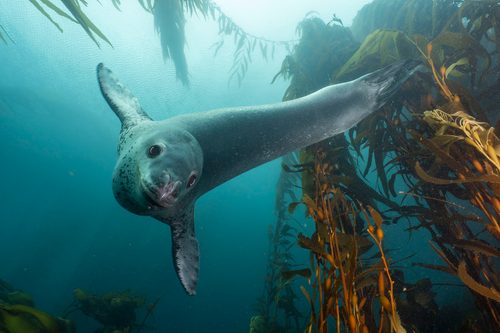
Known predators are killer whales, sharks, male New Zealand sea lions, and possibly leopard seals. New Zealand sea lions are also known to target pups as their prey. Several regurgitations by sea lions have been found to contain remains of fur seal pups, some with plastic tags previously attached to female fur seal pups.

On 23 August 2026, the H5N1 virus, part of an outbreak affecting Australia in the second half of 2026 was detected in a long-nosed fur seal found at Beachport, South Australia. This was the first confirmed case detected in a mammal, leading to fears that the virus may spread to Australian sea lions.

Part of

Where to see it

No dive sites list New Zealand Fur Seal yet. Explore the map to find sites near you.