
← All marine life
Monkfish
Species IUCN · Least Concern (LC)

Monkfish

Lophius piscatorius, Linnaeus, 1758

marine

About Monkfish

Lophius piscatorius, commonly known as the angler, toadfish, sea frog, fishing frog, frogfish, or sea devil, is a species of Lophius in the family Lophiidae. It occurs in coastal and shelf waters of the northeast Atlantic, ranging from the Barents Sea south to the Strait of Gibraltar, and is also present in the Mediterranean and Black Sea. In parts of its range, including the Irish Sea, it supports an important commercial fishery.

Appearance

The average size of European anglers is 40–60 centimetres (16–24 in), with larger specimens exceeding this range. Precise ranges in body size tend to vary between different localities and populations. Average size also tends to increase with depth; populations living in deeper waters are larger-bodied overall than shallow-water ones.

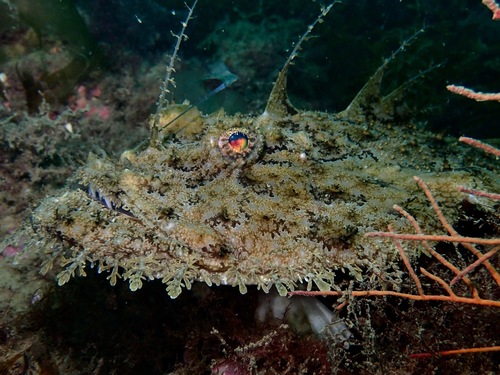
It has a very large head which is broad, flat, and depressed; the rest of the body appears to be a mere appendage. The wide mouth extends all the way around the anterior circumference of the head, and both jaws are armed with bands of long, pointed teeth. These are inclined inwards and can be closed so as to offer no impediment to an object gliding towards the stomach, but to prevent its escape from the mouth.

Habitat

The European angler inhabits muddy and sandy bottoms up to depths of 1,000 metres (3,300 ft). It is occasionally found on rocky bottoms as well. They rarely occur below the continental slope.

Behaviour

The fish has long filaments along the middle of its head, which are, in fact, the detached and modified three first spines of the anterior dorsal fin. The filament most important to the angler is the first, which is the longest, terminates in a lappet, and is movable in every direction. The angler is believed to attract other fish by means of its lure, and then to seize them with its enormous jaws. While it is considered probable that smaller fish are attracted in this way experiments have shown that the actions of the jaw is automatic and depends on the contact of the prey with the tentacle. Its stomach is expandable and it is not unheard of for these fish to swallow prey of their own size.

Reproduction

The spawn of the angler consists of a thin sheet of transparent gelatinous material 60 to 90 cm (2 to 3 ft) wide and 7.5–9 m (25–30 ft) long drifting freely in the water. The eggs in this sheet are in a single layer, each in its own little cavity. The larvae are free-swimming and their pelvic fins are elongated into filaments. As many as 300,000 to 2,800,000 eggs may be released in a single spawning. The egg sheets are buoyant and float near the surface of the water, where the action of wind and surface currents may aid dispersal.

A male angler matures at the age of four years and grows to be 40 cm (16 in) long; whereas the female angler takes two years longer to mature.

Humans & conservation

Lophius piscatorius has historically been considered valuable bycatch in Atlantic fisheries. Captures increased significantly following the development of improvements in deep-water fishing technology. The species has been an important fishery resource in Iberian waters since the 1980s. The related species Lophius budegassa is often caught alongside it, but L. piscatorius is the more abundant of the two.

Part of

Where to see it

No dive sites list Monkfish yet. Explore the map to find sites near you.