
← All marine life
Anglerfish
Group

Anglerfish

Lophiiformes

marine

About Anglerfish

The anglerfish are ray-finned fish in the order Lophiiformes. Both the order's common and scientific name come from the characteristic mode of predation, in which a modified dorsal fin ray acts as a lure for prey (akin to a human angler, and this lure is also likened to a crest or "lophos"). The modified fin ray, with the very tip being the esca and the length of the structure the illicium, is adapted to attract specific prey items depending on the species, through the employment of different luring methods.

Anglerfish occur in marine waters worldwide, from tropical seas to polar regions, and live in both shallow water habitats and the deep sea. Many species are benthic or demersal, including monkfishes, batfishes, frogfishes, and sea toads; these groups use enlarged pectoral and/or pelvic fins to rest on or move across the seabed. In contrast, the deep-sea anglerfish lack pelvic fins and are pelagic, swimming and drifting in the water column.

Anglerfish are notable for their sexual dimorphism, which is sometimes extremely pronounced; the females may be several orders of magnitude larger in mass than males. In the deep-sea anglerfish, this dimorphism has enabled a unique reproductive method, where the male attaches to the much larger female, sometimes fusing together as an example of natural parabiosis. This phenomenon is known as sexual parasitism.

Appearance

Anglerfish are defined by gills that open behind the pectoral fins (as opposed to other fish whose pectorals lay behind the gill opening), depressible teeth that can hinge back, joints of the epiotic bone, the form of the pectoral fin radials, and the luring apparatus (see subsection).

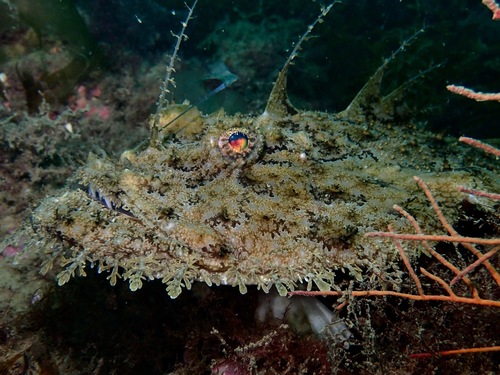
The body form of anglerfish vary by habitat and mode of life. Frogfishes are usually short-bodied and use their limb-like pectoral fins to crawl or perch among reef organisms, usually relying on camouflage. Batfishes and sea toads are usually flattened or globose bottom-dwellers that support themselves on modified fins. In contrast, the pelagic deep-sea anglerfishes have reduced locomotory structures and are usually weak swimmers.
Diet

Anglerfish can wiggle the esca to make it resemble a prey animal, which lures the anglerfish's prey close enough for the anglerfish to devour them whole. Some deep-sea anglerfish of the bathypelagic zone also emit light from their esca to attract prey. In bottom-dwelling species, predation often occurs as luring leading to surprise attacks. Frogfishes resemble sponges, rock, algae, or other benthic organisms and lurk until prep approaches, while batfishes and monkfishes wait on or near the seabed. When prey is within range, the fish opens its large mouth rapidly and pulls it in by suction.

The jaw and stomach of the anglerfish can extend to allow it to consume prey up to twice its size. Because of the limited amount of food available in the anglerfish's environment, this adaptation allows the anglerfish to store food when there is an abundance.

Behaviour

All anglerfish are weak swimmers, including the pelagic deep-sea anglerfish. Demersal species often "walk" on the bottom upon their pectoral and pelvic fins. The pelvic fins were lost in the deep-sea anglers.

The deep-sea anglers often drift without actively swimming; In situ observation of female Oneirodes and whipnose anglerfish (from ROVs) recorded that they often passively float in place or in a current, but they were sometimes observed to attempt to flee from the ROV, beating its pectoral fins in-phase while undulating its tail fin. The lethargic behavior of these ambush predators is suited to the energy-poor environment of the deep sea.

Reproduction

The deep-sea anglerfish employ an unusual mating method: because individuals are locally rare, encounters between two of the same species are also very rare, and finding a mate can be problematic; this has led to the development of sexual parasitism in anglerfish, where the males latch onto their mates using their mouths, which may not be suitable or effective for prey capture. When scientists first started capturing ceratioid anglerfish, they noticed that all of the specimens were female, and on some of these they had what appeared to be parasites attached to them, which turned out to be highly dimorphic male ceratioids. This is one of the few instances of naturally occurring parabiosis. In some species of anglerfish, fusion between male and female when reproducing is possible due to the lack of immune system keys that allow antibodies to mature and create receptors for T-cells.

Humans & conservation

In the History of Animals, Aristotle described the "Fishing-Frog" (one of the local Lophius species, like L. piscatorius or L. budegassa) as an example of a marine species well adapted to their environment, those equipped with "ingenious devices" that it uses to capture prey, alongside the Torpedo. He noted that fishing-frogs that have lost their lure appeared to be thinner than those still intact.

Species in this group

Where to see it

No dive sites list Anglerfish yet. Explore the map to find sites near you.