
← All marine life
Melon-Headed Whale
Species IUCN · Least Concern (LC)

Melon-Headed Whale

Peponocephala electra, (Gray, 1846)

marine

About Melon-Headed Whale

The melon-headed whale (Peponocephala electra), also known less commonly as the electra dolphin, little killer whale, or many-toothed blackfish, is a toothed whale of the oceanic dolphin family (Delphinidae). The common name is derived from the head shape. Melon-headed whales are widely distributed throughout deep tropical and subtropical waters worldwide, but they are rarely encountered at sea. They are found near shore mostly around oceanic islands, such as Hawaii, French Polynesia, and the Philippines.

Appearance

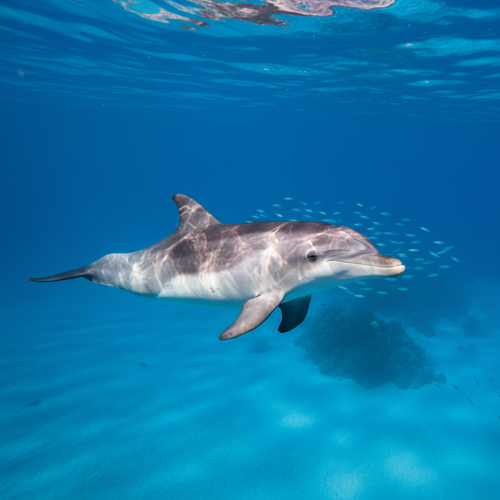
Melon-headed whales have a robust, dolphin-like body, a tapering, conical head (head shape triangular when viewed from above) with no discernible beak and a relatively tall, falcate (sickle-shaped) dorsal fin located near the middle of the back. Body coloration is charcoal-gray to dark-gray body. A dark face 'mask' extends from around the eye to the front of the melon and larger animals have whitish lips. Melon-headed whales have a dark colored dorsal cape that starts narrowly at the front of the head and dips down at a steep angle below the dorsal fin. The boundary between the darker cape and coloration on the flanks is often faint or diffuse. Both the mask and dorsal cape are often only visible in good lighting conditions.
Habitat

Melon-headed whales occur in deep tropical/subtropical oceanic waters, between 40°N and 35°S. Although considered an offshore pelagic species, in some regions there are island-associated populations (e.g., Hawaiʻi) and they can be found close to shore associated with oceanic islands and archipelagoes, such as Palmyra and the Philippines. Sightings or strandings at the extremes of their range are likely associated with extensions of warm currents. Melon-headed whales are not known to be migratory.

Diet

Melon-headed whales may be preyed upon by large sharks and killer whales. Scars and wounds from non-lethal bites of cookie cutter sharks (Isitius brasiliensis) have been observed on free-ranging and stranded animals.

Behaviour

Melon-headed whales feed primarily on pelagic and mesopelagic squid and small fish. Crustaceans (shrimp) have also been reported from stomach contents. Mesopelagic squid and fish species exhibit diel vertical migration behavior, inhabiting greater depths during the day and moving hundreds of meters to shallower depths after dusk to feed on plankton. Melon-headed whales feed at night, when their prey is within the upper 400 m (1,300 ft) of the water column. In the Hawaiian Islands, individuals fitted with depth-transmitting satellite tags made night-time foraging dives that had an average range of 219.5–247.5 m (720–812 ft), with a maximum dive depth of 471.5 m (1,547 ft) recorded.

Reproduction

Little is known about the reproductive behavior of melon-headed whales. The most information comes from analyses of large stranding groups in Japanese waters, where sexual maturity for females is reached at 7 years of age. Females give birth to a single calf every 3–4 years after a gestation of approximately 12 months. Off Japan, the calving season appears to be long (from April to October) without an obvious peak. In Hawaiian waters newborn melon-headed whales have been observed in all months except December, suggesting births occur year-round, but sightings of newborns peak between March and June. Newborn melon-headed whales have been observed in April and June in the Philippines. In the Southern Hemisphere calving also appears to occur over an extended period, from August to December.

Humans & conservation

The world population is unknown, but abundance estimates for large regions are approximately 45,000 in the eastern tropical Pacific Ocean, 2,235 in northern Gulf of Mexico and in the Philippines 920 in the eastern Sulu Sea and 1,380 in Tañon Strait between Cebu and Negros Islands. There are two known populations in Hawaiʻi: a population of approximately 450 individuals resident to shallower waters of the northwest side of Hawaiʻi Island (the 'Kohola resident population') and a much larger population of approximately 8,000 individuals that moves among the main Hawaiian Islands in deeper waters.

Part of

Where to see it

No dive sites list Melon-Headed Whale yet. Explore the map to find sites near you.