
← All marine life
Mediterranean Monk Seal
Species IUCN · Vulnerable (VU)

Mediterranean Monk Seal

Monachus monachus, (Hermann, 1779)

marine

About Mediterranean Monk Seal

The Mediterranean monk seal (Monachus monachus) is a monk seal belonging to the family Phocidae. As of 2026, it is estimated that between 800 and 1000 individuals survive in isolated subpopulations in the Mediterranean, (especially) in the Aegean Sea, the archipelago of Madeira, and the Cabo Blanco area in the northeastern Atlantic Ocean spanning the border of Mauritania and Western Sahara. It is believed to be the world's rarest pinniped species. It is the only extant species in the genus Monachus, the other two monk seal species being in Neomonachus.

Appearance

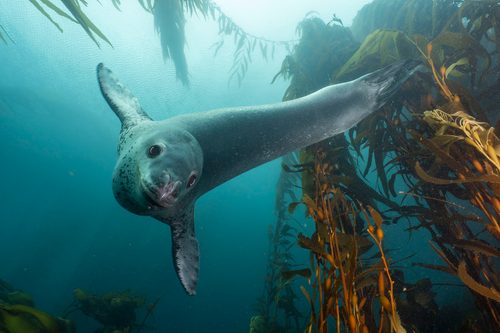
This species of seal grows from approximately 80 centimetres (2.6 ft) long at birth up to an average of 2.4 metres (7.9 ft) as adults, females slightly shorter than males. Males weigh an average of 320 kilograms (710 lb) and females weigh 300 kilograms (660 lb), with overall weight ranging from 240–400 kilograms (530–880 lb). They are thought to live up to 45 years old; the average life span is thought to be 20 to 25 years old and reproductive maturity is reached at around age four.
Habitat

The habitat of this pinniped has changed over the years. In ancient times, and up until the 20th century, Mediterranean monk seals had been known to congregate, give birth, and seek refuge on open beaches. In more recent times, they have left their former habitat and now only use sea caves for these activities. Often these caves are inaccessible to humans. Frequently their caves have underwater entries, and many caves are positioned along remote or rugged coastlines.

Diet

Mediterranean monk seals are diurnal and feed on a variety of fish, crustaceans, and mollusks, primarily octopus, squid, lobsters, mullets, flatfish, tuna, sardines, and eels, up to 3 kg per day. Although they commonly feed in shallow coastal waters, they are also known to forage at depths up to 250 meters, with an average depth varying between specimens. Monk seals prefer hunting in wide-open spaces, enabling them to use their speed more effectively. They are successful bottom-feeding hunters; some have even been observed lifting slabs of rock in search of prey.

Behaviour

Very little is known of this seal's reproduction. As of 2020, it is thought that there are roughly 500 pairs of monk seals remaining in the world. Scientists have suggested that they are polygynous, with males being very territorial where they mate with females. Although there is no breeding season since births take place year-round, there is a peak in September, October, and November. Although mating will take place in the water, females will give birth and care for the pups on beaches or underwater caves. The use of underwater caves may have begun in order to make predatory actions almost impossible as these caves are difficult to access. Because they will stay with the pups to nurse and protect, they use their stored fat reserves to nurse. Data analysis indicates that only 29% of pups born between September and January survive.

Humans & conservation

The Mediterranean monk seal can be found in the Mediterranean Sea off of Croatia, Cyprus, Greece, Albania, and Turkey, as well as the North Atlantic Ocean off of Madeira, Mauritania and Western Sahara. It may be locally extinct (extirpated) in and around Corsica, Egypt, France, Italy, Libya, Malta, Monaco, Montenegro, southern Spain (and the Balearic Islands), and Tunisia. Its status in Algeria, Israel, Lebanon, Morocco and Syria is unknown.

This earless seal's historical range extended from the northern Atlantic coastline of Western Africa east to the Black Sea, including all offshore islands within the Mediterranean, the Canary Islands, Madeira, Desertas, Porto Santo, and as far west as the Azores. Vagrants could be found as far south as The Gambia and the Cape Verde (Cabo Verde) islands, and as far north as Portugal to Northern Spain and the Bay of Biscay to the coast of Brittany.

Part of

Where to see it

No dive sites list Mediterranean Monk Seal yet. Explore the map to find sites near you.