Appearance
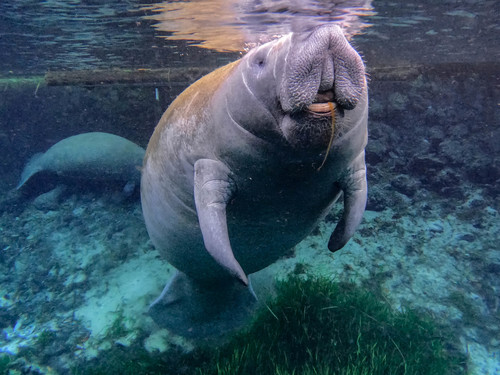
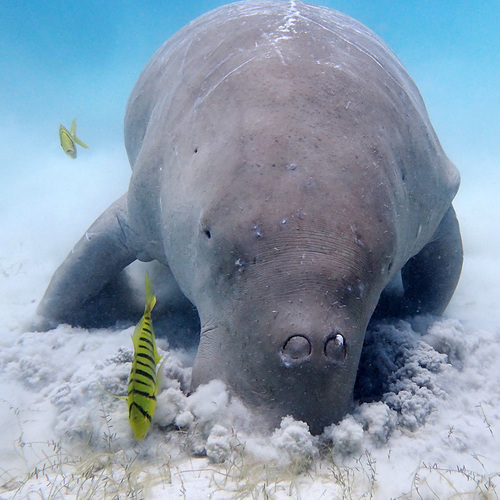
The tail fluke of a dugong is notched and similar to those of dolphins, whereas the tail fluke of manatee is paddle-shaped. The fluke is pumped up and down in long strokes to move the animal forward, or twisted to turn. The forelimbs are paddle-like flippers which aid in turning and slowing. Unlike manatees, the dugong lacks nails on its flippers, which are only 15% of a dugong's body length. Manatees generally glide at speeds of 8 kilometres per hour (5 mph), but can reach speeds of 24 kilometres per hour (15 mph) in short bursts. The body is fusiform to reduce drag in the water. Like those of cetaceans, the hind limbs are internal and vestigial. The snout is angled downwards to aid in bottom-feeding. Sirenians typically make two- to three-minute dives, but manatees can hold their breath for up to 15 minutes while resting and dugongs up to six minutes.