
← All marine life
Magellanic Penguin
Species IUCN · Least Concern (LC)

Magellanic Penguin

Spheniscus magellanicus, (Forster, 1781)

marine

About Magellanic Penguin

The Magellanic penguin (Spheniscus magellanicus) is a South American penguin, breeding in coastal Patagonia, including Argentina, Chile, and the Falkland Islands, with some migrating to Brazil and Uruguay, where they are occasionally seen as far north as Espírito Santo. Vagrants have been found in El Salvador, the Avian Island in Antarctica, Australia, and New Zealand. It is the most numerous of the Spheniscus banded penguins. Its nearest relatives are the African penguin, the Humboldt penguin, and the Galápagos penguins. The Magellanic penguin was named after Portuguese explorer Ferdinand Magellan, who spotted the birds in 1520. The species is listed as being of Least Concern by the IUCN.

Appearance

Magellanic penguins are medium-sized penguins which grow to be 61–76 cm (24–30 in) tall and weigh between 2.7 and 6.5 kg (6.0 and 14.3 lb). The males are larger than the females, and the weight of both drops while the parents raise their young.

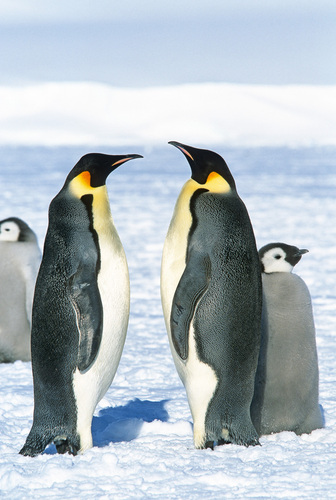
Adults have black backs and white abdomens. There are two black bands between the head and the breast, with the lower band shaped in an inverted horseshoe. The head is black with a broad white border that runs from behind the eye, around the black ear-coverts and chin, and joins at the throat. Chicks and younger penguins have grey-blue backs, with a more faded grey-blue colour on their chest. Magellanic penguins can live up to 25 years in the wild, but as much as 30 years in captivity. Captain Eo, a male Magellanic penguin at the San Francisco Zoo, died in 2022 at the age of 40.
Diet

Magellanic penguins feed in the water, preying primarily on small pelagic fish (Argentine anchoita, silversides, Argentine hake, Falkland sprat, Southern blue whiting, rockcod), hagfish, cuttlefish, squid (Patagonian longfin squid, Gonatus antarcticus, shortfin squid), krill, and squat lobsters, and ingest sea water with their prey. Their salt-excreting gland rids the salt from their bodies. Adult penguins can regularly dive to depths of 20 to 50 m (66 to 164 ft) deep in order to forage for prey. During the breeding season males and females have similar foraging and diving patterns as well as diet composition, however bone tissue analysis suggests that diets diverge post-season when limitations imposed by chick rearing are removed.

Reproduction

Magellanic penguins travel in large groups when hunting for food. In the breeding season, these birds gather in large nesting colonies at the coasts of Argentina, southern Chile, and the Falkland Islands, which have a density of 20 nests per 100 m2 (1,100 sq ft). The breeding season begins with the arrival of adult Magellanic penguins at the breeding colonies in September and extends into late February and March when the chicks are mature enough to leave the colonies. One of the largest of these colonies is located at Punta Tombo. Nests are built under bushes or in burrows. Two eggs are laid. Incubation lasts 39–42 days, a task which the parents share in 10- to 15-day shifts. The chicks are cared for by both parents for 29 days and are fed every two to three days. Normally, both are raised through adulthood, though occasionally only one chick is raised.

Humans & conservation

Magellanic penguin populations face various pressures, including exposure to reported and unreported oil spills, changes in prey availability and climate change. Natural predation occurs by sea lions, giant petrels, and leopard seals which prey on the chicks. The warrah preyed on the penguin prior to its extinction. Its major predator, however, is the puma, which can also take adults; penguins constitute the majority of prey items in puma diet in Patagonia's Bosques Petrificados de Jaramillo National Park and Monte León National Park.

Human interactions can also cause stress to penguin chicks. Newly hatched chicks that are visited by tourists show a stress response, with elevated levels of corticosterone in their blood. The elevated corticosterone is detrimental to the development of muscle strength, growth, and immune function.

Part of

Where to see it

No dive sites list Magellanic Penguin yet. Explore the map to find sites near you.