
← All marine life
Macaroni Penguin
Species IUCN · Vulnerable (VU)

Macaroni Penguin

Eudyptes chrysolophus, (Brandt, 1837)

marine

About Macaroni Penguin

The macaroni penguin (Eudyptes chrysolophus) is a species of penguin found from the Subantarctic to the Antarctic Peninsula. One of eight species of crested penguin, it is very closely related to the royal penguin, and some authorities consider the two to be a single species. It bears a distinctive yellow crest on its forehead. Its face and upperparts are black and sharply delineated from the white underparts. Adults weigh on average 5.5 kg (12 lb) and are 70 cm (28 in) in length. The male and female are similar in appearance; the male is slightly larger and stronger with a larger bill. Like all penguins, it is flightless, with a streamlined body and wings stiffened and flattened into flippers for a marine life.

Its diet consists of a variety of crustaceans, mainly krill, as well as small fish and cephalopods; the species consumes more marine life annually than any other species of seabird. These birds moult once a year, spending about three to four weeks ashore, before returning to the sea. Numbering up to 100,000 individuals, the breeding colonies of the macaroni penguin are among the largest and densest of all penguin species. After spending the summer breeding, penguins disperse into the oceans for six months; a 2009 study found that macaroni penguins from Kerguelen travelled over 10,000 km (6,200 mi) in the central Indian Ocean.

With about 18 million individuals, the macaroni penguin is the most numerous penguin species. Widespread declines in populations have been recorded since the mid-1970s and their conservation status classification is vulnerable.

Appearance

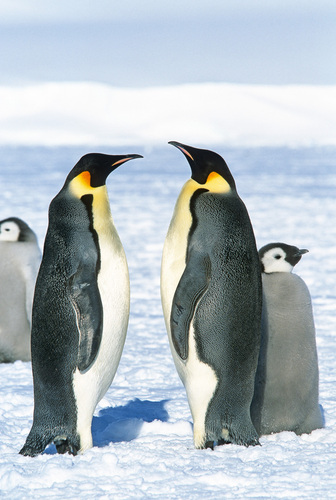
The macaroni penguin is a large, crested penguin, similar in appearance to other members of the genus Eudyptes. An adult bird has an average length of around 70 cm (28 in); the weight varies markedly depending on time of year and sex. Males average from 3.3 kg (7 lb) after incubating, or 3.7 kg (8 lb) after moult to 6.4 kg (14 lb) before moult, while females average 3.2 kg (7 lb) after to 5.7 kg (13 lb) before moult. Among standard measurements, the thick bill (from the gape) measures 7 to 8 cm (2.8 to 3.1 in), the culmen being around a centimetre less. The wing, from the shoulder to the tip, is around 20.4 cm (8.0 in) and the tail is 9–10 cm (3.5–3.9 in) long. The head, chin, throat, and upper parts are black and sharply demarcated against the white under parts. The black plumage has a bluish sheen when new and brownish when old.
Habitat

A 1993 review estimated that the macaroni was the most abundant species of penguin, with a minimum of 11,841,600 pairs worldwide. Macaroni penguins range from the Subantarctic to the Antarctic Peninsula; at least 216 breeding colonies at 50 sites have been recorded. In South America, macaroni penguins are found in southern Chile, the Falkland Islands, South Georgia and the South Sandwich Islands, and South Orkney Islands. They also occupy much of Antarctica and the Antarctic Peninsula, including the northern South Shetland Islands, Bouvet Island, the Prince Edward and Marion islands, the Crozet Islands, the Kerguelen Islands, and the Heard and McDonald Islands. While foraging for food, groups will range north to the islands off Australia, New Zealand, southern Brazil, Tristan da Cunha, and South Africa.

Diet

The macaroni penguin's predators consist of birds and aquatic mammals. The leopard seal (Hydrurga leptonyx), Antarctic fur seal (Arctocephalus gazella), Subantarctic fur seal (A. tropicalis), and killer whale (Orcinus orca) hunt adult macaroni penguins in the water. Macaroni colonies suffer comparatively low rates of predation if undisturbed; predators generally only take eggs and chicks that have been left unattended or abandoned. Skua species, the snowy sheathbill (Chionis alba), and kelp gull (Larus dominicanus) prey on eggs, and skuas and giant petrels also take chicks and sick or injured adult birds.

Behaviour

The diet of the macaroni penguin consists of a variety of crustaceans, squid and fish; the proportions that each makes up vary with locality and season. Krill, particularly Antarctic krill (Euphausia superba), account for over 90% of food during breeding season. Cephalopods and small fish such as the marbled rockcod (Notothenia rossii), painted notie (Lepidonotothen larseni), Champsocephalus gunneri, the lanternfish species Krefftichthys anderssoni, Protomyctophum tenisoni and P. normani become more important during chick-rearing. Like several other penguin species, the macaroni penguin sometimes deliberately swallows small (10– to 30-mm-diameter) stones; this behaviour has been speculated to aid in providing ballast for deep-sea diving, or to help grind food, especially the exoskeletons of crustaceans which are a significant part of its diet.

Reproduction

Female macaroni penguins can begin breeding at around five years of age, while the males do not normally breed until at least six years old. Females breed at a younger age because the male population is larger. Commencing a few days after females arrive at the colony, sexual displays are used by males to attract partners and advertise their territory, and by pairs once together at the nest site and at changeover of incubation shifts. In the 'ecstatic display', a penguin bows forward, making loud throbbing sounds, and then extends its head and neck up until its neck and beak are vertical. The bird then waves its head from side to side, braying loudly. Birds also engage in mutual bowing, trumpeting, and preening. Monitoring of pair fidelity at South Georgia has shown around three-quarters of pairs will breed together again the following year.

Humans & conservation

The population of macaroni penguins is estimated at around 18 million mature individuals; a substantial decline has been recorded in several locations. This includes a 50% reduction in the South Georgia population between the mid-1970s to mid-1990s and the disappearance of the species from Isla Recalada in Southern Chile. This decline of the overall population in the last 30 years has resulted in the classification of the species as globally Vulnerable by the IUCN Red List of Threatened Species. Long-term monitoring programs are underway at a number of breeding colonies, and many of the islands that support breeding populations of this penguin are protected reserves. The Heard Islands and McDonald Islands are World Heritage Sites for the macaroni penguin. The macaroni penguin may be being impacted by commercial fishing and marine pollution.

Part of

Where to see it

No dive sites list Macaroni Penguin yet. Explore the map to find sites near you.