
← All marine life
Longtail Stingray
Species IUCN · Vulnerable (VU)

Longtail Stingray

Hypanus longus, (Garman, 1880)

marine

About Longtail Stingray

The longtail stingray (Hypanus longus, often misspelled longa), is a species of stingray in the family Dasyatidae, found in the eastern Pacific Ocean from Baja California to Colombia. It inhabits sandy habitats down to a depth of 90 m (300 ft). Measuring up to 1.56 m (5.1 ft) across, this species has a rhomboid pectoral fin disc, a lower (but not upper) fin fold on the tail, and numerous dermal denticles along the back and behind the stinging spine. The longtail stingray feeds mainly on bottom-dwelling bony fishes and crustaceans. It is aplacental viviparous, with females giving birth to 1–5 young in late summer. It is caught for food, likely throughout its range, but specific fishery data is lacking.

Appearance

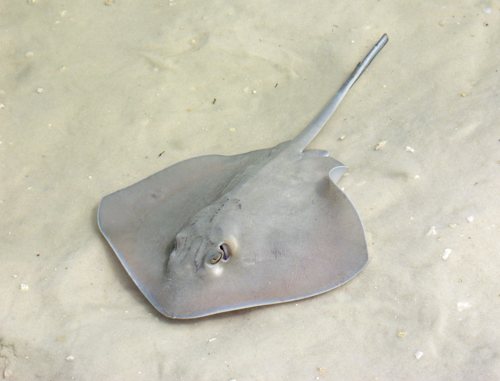
The longtail stingray reaches a maximum known disc width of 1.58 m (5.2 ft), length of 2.57 m (8.4 ft), and weight of 46.4 kg (102 lb). It has a diamond-shaped pectoral fin disc about a sixth wider than long, with the outer corners broadly rounded. The front margins are nearly straight, meeting the tip of the snout at a blunt angle. There is a row of five papillae across the floor of the mouth; the two on the sides are smaller than the others. The pelvic fins are rounded. The whip-like tail bears a stinging spine and measures more than twice as long as the disc. Behind the spine, the tail becomes laterally compressed with a low keel above and a short, narrow fin fold below.
Habitat

The longtail stingray is found along the tropical Pacific coast of the Americas, from central Baja California (though it may occur as far north as San Diego, California) to Colombia, including the Revillagigedo and Galapagos Islands. This species inhabits sandy or muddy flats to a depth of 90 m (300 ft), often near rocky or coral reefs, or in estuaries. In the Galapagos, it was reportedly abundant in the shallow lagoons of mangrove swamps at Fernandina Island.

Behaviour

Apparently solitary in nature, the longtail stingray is a predator of bottom-dwelling bony fishes and invertebrates, in particular stomatopods, decapods, and molluscs. Known parasites of this species include the tapeworms Acanthobothrium cimari, A. cleofanus, A. costarricense, A. puntarenasense, and A. vargasi, Anthocephalum lukei and A. michaeli, Parachristianella dimegacantha, Pseudochristianella elegantissima and P. nudiscula, and Pterobothrioides carvajali, and the monogenean Listrocephalos whittingtoni. Like other stingrays, the longtail stingray is aplacental viviparous with the developing embryos sustained initially by yolk and later by histotroph ("uterine milk") produced by the mother. Adult females have a single functional ovary.

Humans & conservation

The tail spine of the longtail stingray is potentially dangerous to humans. This species is of some commercial importance in Mexico, where it is sold fresh or dried and salted. This species is likely landed by inshore fisheries targeting shark and ray throughout Central America; it is caught by bottom trawls and longlines, and is especially susceptible to gillnets as its tail spine easily becomes entangled in the mesh. The impact of fishing on its population is unknown, as fishery landings in the region are poorly monitored and the longtail stingray is not reported separately from other ray species. The International Union for Conservation of Nature (IUCN) has listed this species as vulnerable, while noting that its slow reproductive rate would limit its capacity to recover from over-exploitation.

Part of

Where to see it

No dive sites list Longtail Stingray yet. Explore the map to find sites near you.