
← All marine life
Long-Finned Pilot Whale
Species IUCN · Least Concern (LC)

Long-Finned Pilot Whale

Globicephala melas, (Traill, 1809)

marine

About Long-Finned Pilot Whale

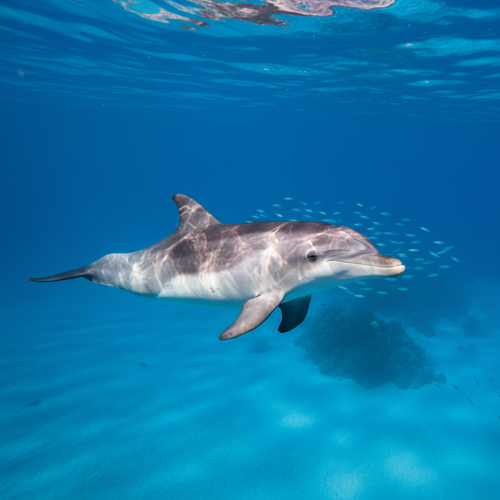
The long-finned pilot whale or pothead whale (Globicephala melas) is a large species of oceanic dolphin. It shares the genus Globicephala with the short-finned pilot whale (Globicephala macrorhynchus). Long-finned pilot whales are known as such because of their unusually long pectoral fins.

Appearance

There is sexual dimorphism in the species. Females grow to a maximum length of up to 6 m (20 ft), and a maximum weight of up to 2,500 kg (5,500 lb). Males are significantly larger at up to 7.6 m (25 ft) in length, and weigh up to 4,500 kg (9,900 lb). This makes the long-finned pilot whale the second largest member of the dolphin family, behind the orca (Orcinus orca).
Habitat

Though long-finned pilot whales appear to be abundant, there have been no recent reliable estimates for the worldwide population and very little long-term baseline data collected for monitoring population trends. However, based on their apparent abundance and what information is available, they are currently listed by the IUCN as "Least Concern." Conservative estimates for the population found off Newfoundland estimated around 13,000 individuals. Another study estimated a total of 780,000 animals in the North Atlantic, though this study includes both short and long-finned pilot whales as they are hard to distinguish at sea.

Diet

Long-finned pilot whales are apex predators, preying on various species of squid, octopus, crustaceans and fish. Examples of fish species recorded as prey include lanternfish, Atlantic herring, silver hake, Atlantic mackerel and spiny dogfish.

Behaviour

Long-finned pilot whales are very social in nature. They are usually seen in groups, which range in size from a couple of individuals to aggregations of over a thousand. However, 20 to 150 individuals are more commonly observed. Studies have shown that this species often forms small long-term social units made up of around 8-12 individuals. Genetic investigations of the pilot whales driven ashore in the Faroese hunts have shown a relatedness amongst whales, suggesting a matrilineal structure within social units. This means that calves - females and perhaps the males as well - remain with their mothers for life.

Reproduction

Females reach sexual maturity at about 8 years of age, while males reach sexual maturity at around 12 years of age.

It seems that mating can take place at any time during the year, but it peaks in late spring/early summer for both northern and southern hemisphere populations. Mating is thought to occur when different groups meet up, and breeding within units is a rare occurrence.

Gestation lasts approximately 12 to 16 months and calving occurs once every 3 to 6 years. Calves are generally 1.6–2.0 m (5 ft 3 in – 6 ft 7 in) at birth, and weigh about 75 kg (165 lb). Most calves are born in the summer, though some calving occurs throughout the year. There is evidence that some males may stay with their mothers after they reach sexual maturity.

Humans & conservation

The North Sea and Baltic Sea populations of the long-finned pilot whale are listed on Appendix II of the Convention on the Conservation of Migratory Species of Wild Animals (CMS), since they have an unfavourable conservation status or would benefit significantly from international co-operation organised by tailored agreements.

Part of

Where to see it

No dive sites list Long-Finned Pilot Whale yet. Explore the map to find sites near you.