
← All marine life
Leopard Seal
Species IUCN · Least Concern (LC)

Leopard Seal

Hydrurga leptonyx, (Blainville, 1820)

marine

About Leopard Seal

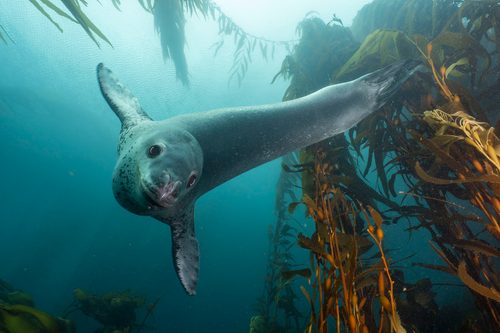
The leopard seal (Hydrurga leptonyx), also referred to as the sea leopard, is a long and muscular seal native to the Southern Ocean of Antarctica and southern Patagonia. It is the second largest species of seal in the Antarctic (after the southern elephant seal). It is the same length as, but half the weight of, a walrus. Its fur coat is countershaded, being silver on the bottom and dark gray on the top, and is distinctive for its leopard-like pattern of dark spots.

The leopard seal is an apex predator, with massive jaws, and teeth which are 2.5 cm (1 in) long. It feeds on a wide range of prey including its fellow pinnipeds, cephalopods, krill, fish, and birds, particularly penguins. Its only natural predator is the orca. It uses its hearing and whiskers to track prey underwater.

It is the only species in the genus Hydrurga. Its closest relatives are the Ross seal, the crabeater seal, and the Weddell seal, which are all Antarctic seals of the tribe Lobodontini.

Appearance

The leopard seal has a distinctively long and muscular body shape when compared to other seals. The overall length of adults is 2.4–3.5 m (7.9–11.5 ft) and their weight is in the range 200 to 600 kilograms (440 to 1,320 lb), making them the same length as the northern walrus but usually less than half the weight. They are covered in a thick layer of blubber that helps to keep them warm while in the cold temperatures of the Antarctic. This blubber also helps to streamline their body making them more hydrodynamic, and thus able to hunt down swift prey. A seal's body condition can be ascertained through blubber thickness, along with general girth, weight, and length measurements.

The leopard seal is sexually dimorphic, with females being up to 50% larger. In the wild, leopard seals can live up to 26 years.
Habitat

Leopard seals are pagophilic ("ice-loving") seals, which primarily inhabit the Antarctic pack ice between 50˚S and 80˚S. Leopard seals are seen in higher densities in West Antarctica than in other regions. A population appears to be resident in Chilean Patagonia, with reproduction being recorded in the region. Leopard seals are also considered by some to be resident species of New Zealand, with reproduction being recorded and individuals being present year-round in all regions of the country.

Behaviour

Using data received from transmitters called satellite-linked depth recorders (SLDRs) and time-depth recorders (TDRs), which are attached to the seals' heads by scientists, it was determined that leopard seals are primarily shallow divers, but capable of diving deeper than 80 metres (260 ft) in search for food. They are able to complete these dives by collapsing their lungs and re-inflating them at the surface. This is possible by increasing the amount of surfactants which coats the alveoli in the lungs for re-inflation. They also have a reinforced trachea to prevent collapse at great depth pressures.

Reproduction

Vocalization is thought to be important in breeding, since males are much more vocal around this time. Mating takes place in the water, and then the male leaves the female to care for the pup, which the female gives birth to after an average gestation period of 274 days. Most leopard seal breeding take place on a pack of ice.

Humans & conservation

Leopard seals are large predators presenting a potential risk to humans. However, attacks on humans are rare. Most human perceptions of leopard seals are shaped by historic encounters between humans and leopard seals that occurred during the early days of Antarctic exploration. Examples of aggressive behavior, stalking, and attacks are rare, but have been documented. A large leopard seal attacked Thomas Orde-Lees (1877–1958), a member of Sir Ernest Shackleton's Imperial Trans-Antarctic Expedition of 1914–1917, when the expedition was camping on the sea-ice. The "sea-leopard", about 12 ft (3.7 m) long and 1,100 lb (500 kg), chased Orde-Lees on the ice. He was saved only when another member of the expedition, Frank Wild, shot it.

Part of

Where to see it

No dive sites list Leopard Seal yet. Explore the map to find sites near you.