
← All marine life
Leatherback Sea Turtle
Species IUCN · Vulnerable (VU)

Leatherback Sea Turtle

Dermochelys coriacea, (Vandelli, 1761)

marine

About Leatherback Sea Turtle

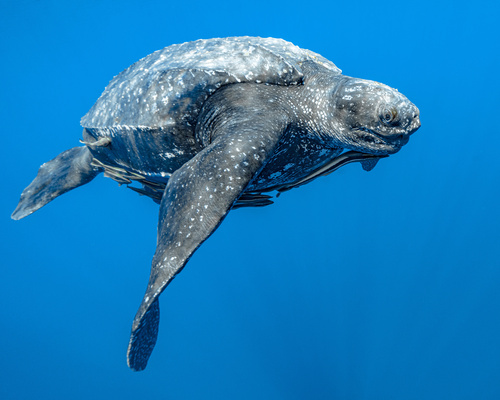
The leatherback sea turtle (Dermochelys coriacea), sometimes called the lute turtle, leathery turtle or simply the luth, is a large species of sea turtle. The largest of all living turtles and the heaviest non-crocodilian reptile, it reaches lengths of up to 2.7 metres (8 ft 10 in) and weights of 500 kilograms (1,100 lb). It is the only living species in the genus Dermochelys and family Dermochelyidae. It can easily be differentiated from other modern sea turtles by its lack of a bony shell; instead, its carapace is covered by oily flesh and flexible, leather-like skin, for which it is named. Leatherback turtles have a global range, although there are multiple distinct subpopulations. The species as a whole is considered vulnerable, and some of its subpopulations are critically endangered.

Appearance

Leatherback turtles have the most hydrodynamic body of any sea turtle, with a large, teardrop-shaped body. A large pair of front flippers powers the turtles through the water. Like other sea turtles, the leatherback has flattened forelimbs adapted for swimming in the open ocean. Claws are absent from both pairs of flippers. The leatherback's flippers are the largest in proportion to its body among extant sea turtles. Leatherback's front flippers can grow up to 2.7 m (8.9 ft) from tip to tip in large specimens, the largest flippers (even in comparison to its body) of any sea turtle.
Habitat

The leatherback turtle is a species with a cosmopolitan global range. Of all the extant sea turtle species, D. coriacea has the widest distribution, reaching as far north as Alaska and Norway and as far south as Cape Agulhas in Africa and the southernmost tip of New Zealand. The leatherback is found in all tropical and subtropical oceans, and its range extends well into the Arctic Circle.

The three major, genetically distinct populations occur in the Atlantic, eastern Pacific, and western Pacific Oceans. While nesting beaches have been identified in the region, leatherback populations in the Indian Ocean remain generally unassessed and unevaluated.

Recent estimates of global nesting populations are that 26,000 to 43,000 females nest annually, which is a dramatic decline from the 115,000 estimated in 1980.

Diet

Adult D. coriacea turtles subsist almost entirely on jellyfish. Due to their obligate feeding nature, leatherbacks help control jellyfish populations. Leatherbacks also feed on other soft-bodied organisms, such as other cnidarians (siphonophores), tunicates (salps and pyrosomas) and cephalopods (squid). They are also believed to feed on small crustaceans (amphipods and crabs), fish (possibly symbiotes with jellies), sea urchins, snails, seagrasses, and algae. Adult turtles consume 73% of their body weight daily.

Behaviour

Leatherback sea turtles can be found primarily in the open ocean. Scientists tracked a leatherback turtle that swam from Jen Womom beach of Tambrauw Regency in Southwest Papua, Indonesia to the US in a 20,000 km (12,000 mi) foraging journey over a period of 647 days. Leatherbacks follow their jellyfish prey throughout the day, resulting in turtles "preferring" deeper water in the daytime, and shallower water at night (when the jellyfish rise up the water column). This hunting strategy often places turtles in very frigid waters. One individual was found actively hunting in waters where temperatures were as low as 0.4 °C (32.7 °F). Following each foraging dive, the leatherback would return to warmer (17.5 °C (63.5 °F)) surface waters to regain body heat before continuing to dive into near-freezing waters.

Reproduction

Mating takes place at sea. Males never leave the water once they enter it, unlike females, which nest on land. After encountering a female (which possibly exudes a pheromone to signal her reproductive status), the male uses head movements, nuzzling, biting, or flipper movements to determine her receptiveness. Males can mate every year but the females mate every two to three years. Fertilization is internal, and multiple males usually mate with a single female. This polyandry does not provide the offspring with any special advantages.

Female leatherbacks are known to nest up to 10 times in a single nesting season giving them the shortest internesting interval of all sea turtles.

Humans & conservation

People around the world still harvest sea turtle eggs. Asian exploitation of turtle nests has been cited as the most significant factor for the species' global population decline. In Southeast Asia, egg harvesting in countries such as Thailand and Malaysia has led to a near-total collapse of local nesting populations. In Malaysia, where the turtle is practically locally extinct, the eggs are considered a delicacy. In the Caribbean, some cultures consider the eggs to be aphrodisiacs.

They are also a major jellyfish predator, which helps keep populations in check. This bears importance to humans, as jellyfish diets consist largely of larval fish, the adults of which are commercially fished by humans.

Part of

Where to see it

No dive sites list Leatherback Sea Turtle yet. Explore the map to find sites near you.