
← All marine life
King Penguin
Species IUCN · Least Concern (LC)

King Penguin

Aptenodytes patagonicus, Miller, 1778

marine

About King Penguin

The king penguin (Aptenodytes patagonicus) is the second largest species of penguin, smaller than but somewhat similar in appearance to the emperor penguin.

King penguins mainly eat lanternfish, squid, and krill. On foraging trips, king penguins repeatedly dive to over 100 metres (300 ft), and have been recorded at depths greater than 300 metres (1,000 ft). Predators of the king penguin include giant petrels, skuas, the snowy sheathbill, the leopard seal, and the orca.

The king penguin breeds on the subantarctic islands at the northern reaches of Antarctica, South Georgia, southern Argentina, and other temperate islands of the region. It also lives on Macquarie Island in the Southern Ocean and the Falkland Islands.

This bird was exploited commercially in the past for its blubber, oil, meat, and feathers. Today it is fully protected.

Appearance

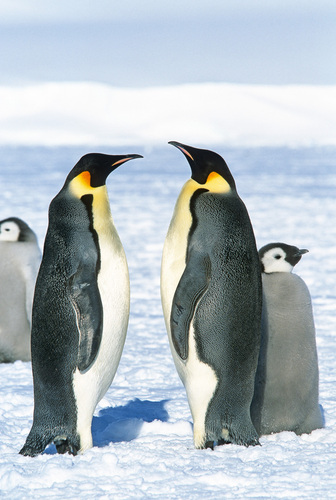
The king penguin stands at 70 to 100 cm (28 to 39 in) tall and weighs from 9.3 to 18 kg (21 to 40 lb). Large individuals can weigh up to around 20 kg (44 lb) before molting. Although female and male king penguins look alike, they can be separated by their calls. Males are also slightly larger than females. The mean body mass of adults from Marion Island was 12.4 kg (27 lb) for 70 males and 11.1 kg (24 lb) for 71 females. Another study from Marion Island found that the mean mass of 33 adults feeding chicks was 13.1 kg (29 lb). The king penguin is approximately 25% shorter and weighs around a third less than the emperor penguin.
Habitat

King penguins breed on subantarctic islands between 45 and 55°S, at the northern reaches of Antarctica, as well as Tierra del Fuego (Argentinian part), the Falkland Islands, and other temperate islands of the region. The total population is estimated to be 2.23 million pairs and is increasing. The largest breeding populations are on the Crozet Islands, with around 455,000 pairs, 228,000 pairs on the Prince Edward Islands, 240,000–280,000 on the Kerguelen Islands, and over 100,000 in the South Georgia archipelago.

Diet

King penguins eat various species of small fish, squid, and krill. Fish constitute roughly 80% of their diet, except in the winter months of July and August, when they make up only around 30%. Lanternfish are the main fish taken, principally the species Electrona carlsbergi and Krefftichthys anderssoni, as well as Protomyctophum tenisoni. Slender escolar (Paradiplospinus gracilis) of the Gempylidae and Champsocephalus gunneri are also consumed. Cephalopods consumed include those of the genus Moroteuthis, the hooked squid (Moroteuthopsis longimana), the sevenstar flying squid (Martialia hyadesii), young Gonatus antarcticus, and Onychoteuthis species.

Behaviour

American zoologist Gerry Kooyman revolutionised the study of penguin foraging behaviour in 1971 when he published his results from attaching automatic dive-recording devices to emperor penguins, and recording a dive of 235 metres (771 ft) by a king penguin in 1982. The current maximum dive recorded is 343 metres in the Falkland Islands region, and a maximum time submerged of 552 seconds was recorded at the Crozet Islands. The king penguin dives during daylight hours to depths of 100–300 metres (330–980 ft), spending around five minutes submerged, and to less than 30 metres (98 ft) at night.

Reproduction

The king penguin is able to breed at three years of age, although only a very small minority (5% recorded at Crozet Islands) actually do then; the average age of first breeding is around 5–6 years. King penguins are serially monogamous. They have only one mate each year, and stay faithful to that mate. However, fidelity between years is less than 30%. The unusually long breeding cycle probably contributes to this low rate.

Humans & conservation

In less than 80 years, 70% of the king penguin population is expected to disappear. Considered sensitive indicators of changes in marine ecosystems, king penguins serve as a key species for understanding the effects of climate change on the marine biome, especially throughout the sub-Antarctic and Antarctic areas.

Part of

Where to see it

No dive sites list King Penguin yet. Explore the map to find sites near you.