
← All marine life
Kemp's Ridley Sea Turtle
Species IUCN · Critically Endangered (CR)

Kemp's Ridley Sea Turtle

Lepidochelys kempii, Garman, 1880

marine

About Kemp's Ridley Sea Turtle

Kemp's ridley sea turtle (Lepidochelys kempii), also called commonly the Atlantic ridley sea turtle, Kemp's ridley turtle, and Kemp's ridley, is a species of turtle in the family Cheloniidae. L. kempii is the rarest species of sea turtle and is the world's most endangered species of sea turtle as well as the smallest. It is one of two living species in the genus Lepidochelys (the other one being L. olivacea, the olive ridley sea turtle). L. kempii primarily occupies habitat around the Gulf of Mexico, though its migrations into the Atlantic Ocean are being affected by rising temperatures. Rising sea temperatures expand this species' range, leaving them vulnerable to cold-shocking events when weather changes. Kemp's ridley sea turtle is listed as endangered under the Endangered Species Act (ESA), and conservation efforts are attempting to rebuild population numbers. Human activity, including habitat destruction, climate change, and oil spills, threatens populations.

Appearance

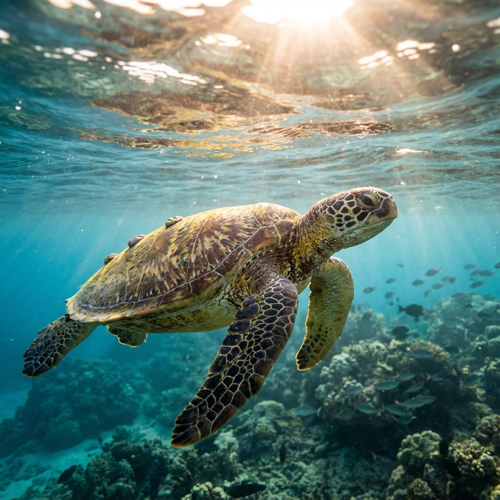
Kemp's ridley is the smallest of all sea turtle species, with a carapace length of 58–70 cm (23–28 in) and weight of only 36–45 kg (80–100 lb) at maturity. Typical of sea turtles, it has a dorsoventrally depressed body with specially adapted flipper-like front limbs and a beak. Kemp's ridley turtle adults reach a maximum of 75 cm (30 in) in carapace length and weigh a maximum of 50 kg (110 lb). The adult's oval carapace is almost as wide as it is long and is usually olive-gray in color. The carapace has five pairs of costal scutes. In each bridge adjoining the plastron to the carapace are four inframarginal scutes, each of which is perforated by a pore. The head has two pairs of prefrontal scales.
Habitat

The distribution of L. kempii is somewhat unusual compared to most reptiles, varying significantly among adults and juveniles, as well as males and females. Adults primarily live in the Gulf of Mexico, where they forage in the relatively shallow waters of the continental shelf (up to 409 m deep, but typically 50 m or less), with females ranging from the southern coast of the Florida Peninsula to the northern coast of the Yucatán Peninsula, while males have a tendency to remain closer to the nesting beaches in the Western Gulf waters of Texas (US), Tamaulipas, and Veracruz (Mexico). Adults of L. kempii are rarely found outside of the Gulf of Mexico and only 2–4% from the Atlantic are adults.

Diet

Kemp's ridley turtle feeds on mollusks, crustaceans (such as floating crabs and shrimp), jellyfish, fish, algae or seaweed, and sea urchins. Juveniles primarily are pelagic surface-feeders, while adults are opportunistic bottom-feeders that feed primarily on crabs. Research has shown that dives made by these turtles, including those made to forage, may be longer at night. Comparing dietary habits of head-started turtles (turtles raised in captivity before release) and wild turtles found little difference in variance in feeding habits, but variability exists in feeding habits due to habitat differences and maturation of the turtles. Variation in habitat region, as well as prey availability, was found to alter diet composition. Regional diet compositions aid in conservation efforts through enabling predicting food sources becoming affected by major events.

Behaviour

Most females return each year to a single beach—Rancho Nuevo in the Mexican state of Tamaulipas—to lay eggs. The females arrive in large groups of hundreds or thousands in nesting aggregations called arribadas, which is a Spanish word for "arrivals". Males will typically stay closer to breeding grounds.

Juvenile turtles tend to live in floating sargassum seaweed beds for their first years. Then, they range between northwest Atlantic waters and the Gulf of Mexico while growing into maturity.

They reach sexual maturity at the age of 10–12.

This is the only species that nests primarily during the day.

Humans & conservation

Kemp's ridley sea turtle is currently listed as endangered under the Endangered Species Act (ESA). Egg harvesting and poaching first depleted the numbers of Kemp's ridley sea turtles. Still, today, major threats include habitat loss, pollution, and entanglement in shrimping nets. Some major current conservation efforts are aimed towards habitat protection, reduction of bycatch, rescue and rehabilitation, and reduction of killing.

Part of

Where to see it

No dive sites list Kemp's Ridley Sea Turtle yet. Explore the map to find sites near you.