
← All marine life
Species IUCN · Least Concern (LC)

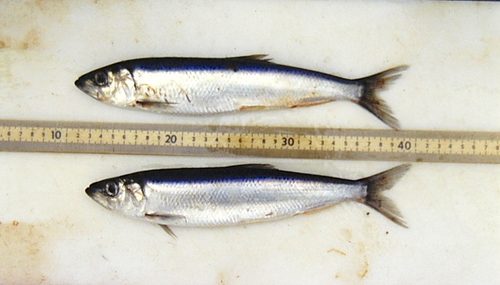
Japanese Sardine

Sardinops melanostictus, (Jenyns, 1842)

marine

About Japanese Sardine

Sardinops is a genus of sardines of the family Alosidae. It is found in the Indo-Pacific, East Pacific, Southeastern Atlantic, and southwestern Indian oceans. Its length is up to 40 cm (16 in). It has numerous common or vernacular names, some of which more appropriately refer to subspecies, including blue pilchard, blue-bait, South American pilchard, Chilean sardine, and Pacific sardine.

Often considered monotypic with only member as Sardinops sagax, it currently has three valid extant species:

Sardinops melanosticta (Temminck & Schlegel, 1846) (Japanese pilchard)

Sardinops ocellatus (Pappe, 1853) (Southern African pilchard)

Sardinops sagax caeruleus (Girard, 1854) (Californian pilchard)

Sardinops sagax neopilchardus (Steindachner, 1879) (Australian pilchard)

Sardinops sagax sagax (Jenyns, 1842) (Peruvian Pacific sardine)

An extinct species, S. humboldti, was described in 2025 from Miocene fossils found in southern Peru.

Humans & conservation

The South Australian sardine fishery targets Sardinops sagax and is the highest yielding single species fishery in Australia by volume. The fishery employs the technique of purse seining, which contributes to the sardines' status as sustainable. Schools of sardines are encircled by a net up to 1 kilometre in length which is then drawn closed at the bottom. The catch is then pumped on board the fishing vessel where it is stored in refrigerated holds at below freezing temperatures. 94% of the catch is used as feed in Southern bluefin tuna ranching operations off Port Lincoln, South Australia. The remaining 6% of the catch serves human consumption, recreational fishing bait and premium pet food markets.
Part of

Where to see it

No dive sites list Japanese Sardine yet. Explore the map to find sites near you.