
← All marine life
Japanese Jack Mackerel
Species IUCN · Near Threatened (NT)

Japanese Jack Mackerel

Trachurus japonicus, (Temminck & Schlegel, 1844)

marine

About Japanese Jack Mackerel

The Japanese jack mackerel (Trachurus japonicus), also known as the Japanese horse mackerel or Japanese scad, is a species named after its resemblance to mackerel but which is in the family Carangidae, the jacks, pompanos, trevallies and scads. Their maximum reported length is 50 cm (20 in) with a common length of 35 cm (14 in). They have a maximum reported weight of 0.66 kg (1.5 lb) and a maximum reported age of 12 years. They are found around the coast of Japan, except Okinawa Island, usually on sandy bottoms of 50–275 m (164–902 ft) deep. They feed mainly on small crustaceans such as copepods, as well as shrimp and small fish. They are similar to the yellowtail horse mackerel around New Zealand and Australia, apart from having more gill rakers and larger eyes.

The Japanese name for the horse mackerel is aji (あじ) and by default generally implies the species Trachurus japonicus, which can be more specifically referred to as ma-aji (まあじ; lit. 'true aji'). The name is most commonly written in hiragana; although a kanji (鯵・鰺) does exist, it is not in common use. It is commonly deep fried or salt-grilled.

In Korean cuisine, the fish is dubbed jeon-gaeng-i (전갱이) and is the default horse mackerel designated by this name. It is commonly grilled or fried as a jeon-gaeng-i gui (전갱이 구이). Among the specialties of Jeju cuisine is the soup gagjaegi-gug (각재기국), the name of which is derived from the name for the fish in the Jeju language.

Appearance

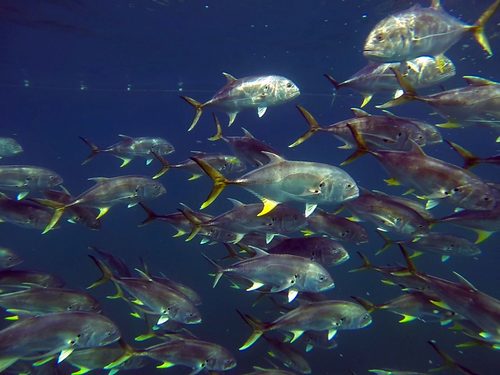
The Japanese jack mackerel (Trachurus japonicus) is a small fish with an average length between 13 – 40 cm, and a maximum recorded size of 50 cm. It is greyish blue on its back, having a silver color on its underside, with a black blotch over the gills. The dorsal and pectoral fins are a dusky color whereas the pelvic and anal fins are pale. One of the main distinguishing features of the Japanese Jack Mackerel is its bright yellow caudal fin which stands out compared to the rest of the species' coloration. Its scales are common among other species in its family, being dense in a horizontal and coarse in a vertical direction with a bend in the midpoint of the scale to follow the curvature of the animal. Scales on anterior half of the species have this curve, while those on the posterior half are straight, with any scales in between these two sections being pointed.
Habitat

The Japanese jack mackerel generally lives in and around the East China Sea and Sea of Japan, in tropical regions between the coordinates of 46°N – 13°N and 105°E – 148°E. Although these are the main population grounds of the Japanese Jack Mackerel, they are also found in southern Japan, the Korean peninsula and in the Pacific Ocean off the coast of southeast Asia, primarily in Taiwan. These locations vary depending on the temperature of the water primarily, and thus vary with the seasons, with a higher density of Japanese Jack Mackerel in the southern and central china seas in the colder months. The ideal condition for the species ranges between 15 – 26 °C, with an ideal temperature of around 21 °C.

Diet

As a juvenile, the Japanese jack mackerel mainly feeds on zooplankton, drift algae and flotsam throughout its developmental phases. Throughout maturity, it feeds on a much wider variety of species, although it mostly feeds on copepods, which are small crustaceans normally 1 – 2 mm in size. Additionally, the Japanese Jack Mackerel feeds on small shrimp or other small fish. The species normally hunts in large schools but in the case of individuals residing in reefs, they have been documented accompanying jellyfish for both feeding and protective purposes. The jellyfish are not a part of the jack mackerel's diet, but they rather use the jellyfish as a method for food collection and a way to hide from predators when not a part of a larger school.

Behaviour

The life cycle of the Japanese jack mackerel starts in the late winter and tend to spawn around late April to early July, as water temperatures begin to rise allowing larvae and juveniles to thrive. as an egg 0.87 – 0.9mm in diameter with a light brown oil globule 0.17 – 0.22mm in diameter which constitutes the yolk of the egg. The location for spawning is dictated by several factors including phytoplankton productivity and migrating ability, but primarily temperature. The eggs are Pelagic, therefore float freely through the open sea and continue to do so as larvae. Once hatched, the larvae are 2.3 – 2.5mm in length and continue to carry the yolk sack beyond the anterior margin of the head. This continues until the 4th day after hatching where the yolk sack is completely absorbed.

Humans & conservation

As larvae and juveniles, the main threat posed to Japanese jack mackerel are the larger fish which feed on the vulnerable developing fish, as it lacks the mobility of a mature individual. As a mature adult, the Jack Mackerel is hunted by other pelagic species such as tuna, sea lions, sharks, and dolphins. Additionally, sea birds pose a great threat to both mature and juvenile Japanese Jack mackerel, as juveniles stay closer to the surface and adults venture to shallow waters to occasionally feed.

Part of

Where to see it

No dive sites list Japanese Jack Mackerel yet. Explore the map to find sites near you.