
← All marine life
Humpback Grouper
Species IUCN · Data Deficient (DD)

Humpback Grouper

Chromileptes altivelis, (Valenciennes, 1828)

marine

About Humpback Grouper

The humpback grouper (Chromileptes altivelis), also known as the panther grouper, (in Australia) barramundi cod, (in the Philippines, in Tagalog) lapu-lapung senorita, (in the Philippines, in Bisayan) miro-miro, (in France) mérou de Grace Kelly, (in Japan) sarasa-hata, (in India) kalava, and many other local names, is a species of marine ray-finned fish. Specifically, it is a grouper from the subfamily Epinephelinae, which is in the family Serranidae, which also includes the anthias and sea basses. It occurs in the Western Pacific Ocean.

Appearance

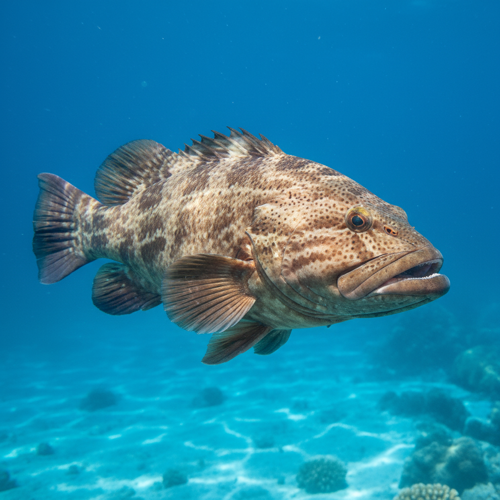
The humpback grouper is a medium-sized fish which grows up to 70 cm (28 in). Its particular body shape makes this grouper difficult to confuse with other fishes. Its body is compressed laterally, is relatively high, and has a unique head profile compared to other groupers. The head is depressed anteriorly and elevated posteriorly, with a sharp rise at the nape. This stocky and strange visual effect gives it the unique humpbacked appearance.In addition, there has been genetic evidence of increased activity in this fish's frontal osteoblasts. This may be the genetic basis for the change of C. altivelis' frontal bone to the sunken, 'humpback,' head.
Habitat

It is widely distributed throughout the tropical waters of the central Indo-West Pacific region. The humpback grouper lives in clear waters from lagoons and seaward reefs with a preference for dead or silty areas. They are found in a range of depth from 2 to 40 m (10 to 130 ft), but usually found at depths less than 10 m (30 ft).

The humpback fish has a preferendum temperature of 24.5 C, similar to other cool, temperate, freshwater fishes.

Diet

The diet of this grouper is based on small fishes and crustaceans, such as krill, shrimp, squids, and clams. In human care, they are commonly fed fresh or dried fish. Like the other members of its family, the humpback grouper is demersal, solitary (except during mating periods), defends a territory, and is an ambush predator. Its feeding activity is maximal at sunrise and/or at sunset.

Because of their carnivorous diet, C. altivelis has been commonly blamed for Ciguatera poisoning throughout their native and non-nonnative distribution.

Behaviour

This species is a protogynous hermaphrodite; in other words, all individuals are born female, with the ability to transform to males as they grow older. Female humpback groupers start transitioning to males as early as 3 years. By the age of 9, most humpback groupers are male. Typically, only the most dominant, mature females undergo this transformation in the absence of a dominant male.

Although primarily solitary, they are also known to swim in pairs, or sometimes in groups of 3–6. The purpose of these groups is unknown.

Compared to other closely related groupers, the humpback grouper has a slow growth rate, with female humpback groupers maturing around 1.5 years.

Cryopreservation has been tested with these humpback grouper embryos, with the survival rate of 7.55% and maximum time of viability being 5 days.

Humans & conservation

The humpback grouper has been given the Data Deficient status by the IUCN. It is a highly valued food fish, especially in Southeast Asia where it is also overexploited. It is bred in aquaculture, but there is no evidence that captive breeding has reduced the fishing pressure on wild populations. Despite this, it is suspected that the population has declined historically.

Australia has put strong conservation measures in place for this species (no take species on the Great Barrier Reef and strict possession limits elsewhere, e.g. Western Australia). Size limits apply in commercial fisheries such as the Torres Strait reef line fishery. However, it is lacking protection elsewhere.

Other potentially effective management techniques to preserve the humpback grouper would be implementing size limits, no-take areas, and increasing effort control.

Part of

Where to see it

No dive sites list Humpback Grouper yet. Explore the map to find sites near you.