
← All marine life
Humboldt Penguin
Species IUCN · Vulnerable (VU)

Humboldt Penguin

Spheniscus humboldti, Meyen, 1834

marine

About Humboldt Penguin

The Humboldt penguin (Spheniscus humboldti) is a medium-sized penguin. It resides in South America, along the Pacific coast of Peru and Chile. Its nearest relatives are the African penguin, the Magellanic penguin and the Galápagos penguin. The Humboldt penguin and the cold water current it swims in are both named after the explorer Alexander von Humboldt. The species is listed as vulnerable by the IUCN with no population recovery plan in place. The current wild population is composed of roughly 23,800 mature individuals and is declining. It is a migrant species.

Humboldt penguins nest on islands and rocky coasts, burrowing holes in guano and sometimes using scrapes or caves. In South America the Humboldt penguin is found only along the Pacific coast, and the range of the Humboldt penguin overlaps that of the Magellanic penguin on the central Chilean coast. It is vagrant in Ecuador and Colombia. The Humboldt penguin has been known to live in mixed species colonies with the Magellanic penguin in at least two different locations at the south of Chile.

The Humboldt penguin has become a focus of ecotourism over the last decades.

Appearance

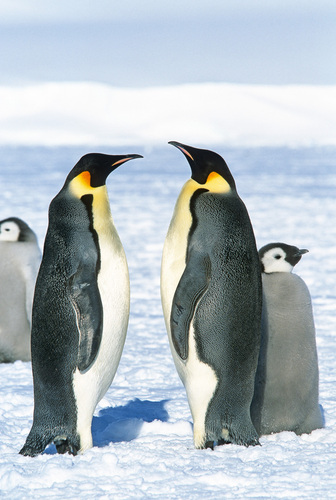
Humboldt penguins are medium-sized penguins, growing to 56–70 cm (22–28 in) long and a weight of 2.9 to 6 kg (6.4 to 13.2 lb). The sex of the Humboldt penguin cannot be recognised via differences in plumage, as they are monomorphic. The male is heavier and larger than the females. Their sex can be determined via head width and bill length; the male has a longer bill than the female. While all the Spheniscus penguins are close to each other in size, the Humboldt penguin is the heaviest species in the genus, with 123 females weighing 4.05 kg (8.9 lb) on average and 165 males averaging 4.7 kg (10 lb). Humboldt penguins have a black head with a white border that runs from behind the eye, around the black ear-coverts and chin, and joins at the throat. They have blackish-grey upperparts and whitish underparts, with a black breast-band that extends down the flanks to the thigh.
Habitat

The Humboldt penguin is endemic to the west coast of South America.

The Humboldt penguin's breeding distribution ranges from southern Chile along the dry and arid coastal regions of the Atacama Desert to subtropical Isla Foca in north Peru. Its range is restricted to the coast and offshore islands affected by the Humboldt current, which provides a continuous supply of nutrients and food, thus supporting huge populations of seabird. In Chile, the most important breeding colony is at Isla Chañaral.

In July 2002, a Humboldt penguin was caught in a fishing net off the coast of Prince of Wales Island in Alaska. The penguin was released from the net, and eventually sent back to the water by one of the fishermen. This is the first and only record of a penguin in the wild in North America. It is unknown whether the penguin was a wild penguin or an escaped pet or zoo animal.

Behaviour

The Humboldt penguin feeds predominantly on pelagic schooling fish. The consumption of cephalopods (namely Antarctic flying squid) and crustaceans vary between populations. Northern colonies consume primarily Atlantic saury and garfish, whilst southern populations primarily consume anchovy, Araucanian herring, silver-side, pilchard and squid. There are seasonal differences in the Humboldt penguin's diet that reflect the changes in availability of fish species across seasons.

Reproduction

The Humboldt penguin nests in loose colonies, with most pairs laying two eggs of the same size 4 days apart that require 41 days of incubation. Their breeding schedule is adjusted depending on the abundance of food. They breed immediately after moulting, when food is abundant and solar radiation is reduced.

The Humboldt penguin lay eggs from March to December, but also with peaks in April and August–September, due to individuals having a second clutch. Half of the females successfully have two clutches per year and most were double broods. If pairs lose their eggs during the first breeding season, they lay a new clutch within 1–4 months. The incubation shifts last, on average, 2.5 days, before one parent takes over and allows the other to forage. There are no differences in the contribution to provisioning from the male and female parents.

Humans & conservation

The ecosystem of the Humboldt current is affected by the El Niño phenomenon. During the El Niño, upwelling of nutrient-rich bottom water in the south-eastern Pacific Ocean is depressed, as well as sea surface temperature anomaly (SSTA) value increases. Massive mortality, especially of juveniles, nest desertion and lack of reproduction occurs. Humboldt penguins migrate south as marine productivity decreases, following the anchovy stocks. Humboldt penguins expend more time and energy foraging as SSTA increases. By 2025 there are fewer than 500 Humboldt Penguins, first the Avian flu spread through the reserve. El Niño struck next which pushed the penguins main food source further out of reach in the deep parts of the ocean. Because of the intense weather changes a potential super El Niño is now on its way.

Part of

Where to see it

No dive sites list Humboldt Penguin yet. Explore the map to find sites near you.