
← All marine life
Hooded Seal
Species IUCN · Endangered (EN)

Hooded Seal

Cystophora cristata, (Erxleben, 1777)

marine

About Hooded Seal

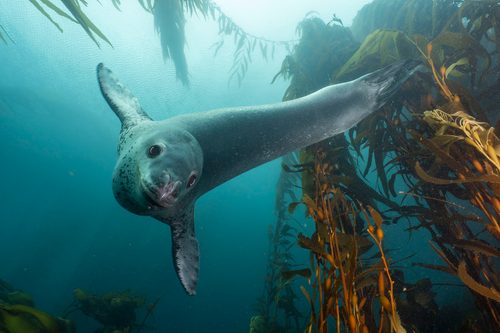
The hooded seal or bladdernose seal (Cystophora cristata) is a large phocid found only in the central and western North Atlantic, ranging from Svalbard in the east to the Gulf of St. Lawrence in the west. The seals are typically silver-grey or white in color, with black spots that vary in size covering most of the body. Hooded seal pups are known as "blue-backs" because their coats are blue-grey on the back with whitish bellies. This coat is shed after 14 months of age when the pups molt. It is the only species in the genus Cystophora.

Appearance

Adult males are 2.6 meters (8 ft 6 in) long on average, can grow to 3.5 m, and weigh 300–410 kg (660–900 lb). Sexual dimorphism is obvious from birth and females are much smaller: 2.03 meters (6 ft 8 in) long and weighing 145–300 kg (320–661 lb). The color is silvery; the body is scattered with dark, irregular marks. The head is darker than the rest of the body, and without marks.
Habitat

Hooded seals live primarily on drifting pack ice and in deep water in the Arctic Ocean and North Atlantic. Although some drift away to warmer regions during the year, their best survival rate is in colder climates. They can be found on four distinct areas with pack ice: near Jan Mayen Island (northeast of Iceland); off Labrador and northeastern Newfoundland; the Gulf of St. Lawrence; and the Davis Strait (off midwestern Greenland). Males appear to be localized around areas of complex seabed, such as Baffin Bay, Davis Strait, and the Flemish cap, while females concentrate their habitat efforts primarily on shelf areas, such as the Labrador Shelf. Hooded seals are known to be a highly migratory species that often wander long distances, as far west as Alaska and as far south as the Canary Islands and Guadeloupe.

Diet

The diet of the hooded seal is composed primarily of various amphipods (crustaceans), euphausiids (krill), and fish, including Atlantic argentine, capelin, Greenland halibut, flounder, polar cod, herring, and redfish. They also are known to eat octopus, squid, sea stars, shrimp, other crustaceans, and mussels. Relative to the other species, hooded seals consume 3 times the proportion of redfish; percentages of capelin were similar in relation to closely related species. Capelin is considered a more common choice of sustenance during the winter season. Their diet is considered to be rich in lipids and fatty acids.

Behaviour

Hooded seals tend to feed in relatively deep waters ranging from 100–600 m (330–1,970 ft), and dive from 5 to 25 minute durations. However, some dives can go deeper than 1,016 m (3,333 ft) and as long, or longer, than 52 minutes. Diving is rather continuous, with approximately 90% of their time spent submerged during the day and night, although dives during the day are generally deeper and longer. Dives during the winter are also deeper and longer than those in the summer. It is known that the hooded seal is generally a solitary species, except during breeding and molting seasons. During these two periods, they tend to fast as well. The seals mass annually near the Denmark strait around July, at the time of their molting periods, to mate. Hooded seals are a relatively unsocial species compared to other seals, and they are typically more aggressive and territorial.

Reproduction

There are four major breeding areas for the hooded seal: the Gulf of St. Lawrence; the "Front" east of Newfoundland; Davis Strait (between Greenland and northern Canada); and the West Ice near Jan Mayen. Male hooded seals are known to have several mates in a single mating season, following the hypothesis that they are polygynous. While some males will defend and mate with just one female for long periods of time, others will be more mobile and tend to mate with multiple females for shorter periods of time, generating maximum offspring within the population. Most males reach sexual maturity by 5 years of age.

Humans & conservation

Prior to the 1940s, adult hooded seals were primarily hunted for their leather and oil deposits. More recently, the main threats are hunting, including subsistence hunting, and bycatch. Seal strandings are not considered a large threat to hooded seal populations but are highly researched. Seal pups are hunted for their blue and black pelts and many mothers are killed in the process, attempting to protect their young. Hunting primarily occurs in areas of Greenland, Canada, Russia, and Norway. Overall, northwest Atlantic hooded seal populations are stable or increasing whereas the northeast Atlantic populations have declined by 85–90% within the last 60 years.

Part of

Where to see it

No dive sites list Hooded Seal yet. Explore the map to find sites near you.