
← All marine life
Honeycomb Stingray
Species IUCN · Endangered (EN)

Honeycomb Stingray

Himantura uarnak, (Gmelin, 1789)

marinebrackish

About Honeycomb Stingray

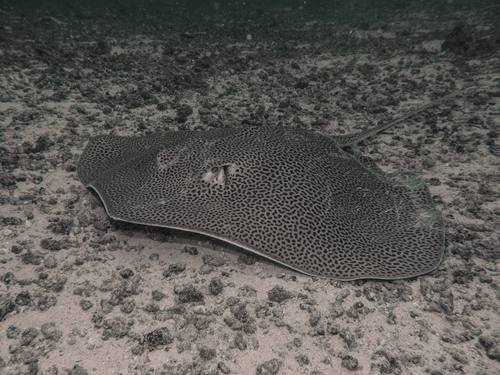
The reticulate whipray or honeycomb stingray (Himantura uarnak) is a species of stingray in the family Dasyatidae. It inhabits coastal waters in the western Indian Ocean including the Red Sea, Natal and the Arabian Sea; also a Lessepsian transmigrant in the eastern Mediterranean. A large species reaching 2 m (6.6 ft) in width, the reticulate whipray has a diamond-shaped pectoral fin disc and an extremely long tail without fin folds. Both its common and scientific names refer to its ornate dorsal color pattern of many small, close-set dark spots or reticulations on a lighter background. However, the reticulate whipray is only one of several large spotted stingrays in the Indo-Pacific which, coupled with the variability of its coloration with age and locality, has resulted in a great deal of taxonomic confusion.

Appearance

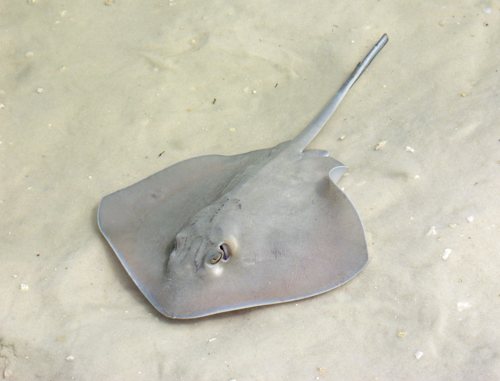
The pectoral fin disc of the reticulate whipray is diamond-shaped and wider than long, with the leading margins almost straight and the snout and outer corners quadrangular. The pectoral fin apex is narrowly rounded with the anterior margin almost straight. In juveniles, the disc is about as wide as long, with a more obtuse snout and rounded corners.
Habitat

Habitat of the reticulate whipray includes coral reefs, brackish water and marine environments. Within these ecosystems they can be found inshore and on soft substrates. Distribution occurs in the North of Taiwan, the Western Indian Ocean (mainly in Malaysia, Myanmar, Indo-Pacific), The Red Sea, west to the Natal in South Africa, and the Arabian Sea. It also entered 30 years ago the Mediterranean Sea through the Suez Canal and it is now common in the south eastern Mediterranean. The recently described H. australis formerly confused with H. uarnak seems to be common only in Australian waters, where it occurs from Shark Bay to Brisbane.

Behaviour

During the day, the reticulate whipray is generally inactive and spends much time resting motionless on the sea floor, sometimes buried in sand. In Shark Bay, Western Australia, this ray can be found resting singly or in small groups in very shallow water during high tide. Life history in shallow, bright light conditions have evolved the ray's sight to specialize for photopic vision. These eyes contain a concentration of ganglion cells, cones and spatial resolving power that indicate color vision, elongated horizontal specialization of visual acuity.

Humans & conservation

The reticulate whipray fights strongly on hook-and-line and is thus popular with recreational anglers, who usually release it alive. This species is caught by intensive artisanal and commercial fisheries operating in parts of the western Indian Ocean, using bottom trawls, gillnets and tangle nets, beach seines, and longlines. Fisheries off the coasts of Pakistan have also documented catching reticulate whiprays with one study stating that from 1977-2019 approximately more than 2840 m tones of the uarnak complex caught as bycatch from fisheries. 1982 was documented to be the peak commercial stingray fishing era with more than 49,017 m tons of stingrays caught and sold. Peak season to catch whiprays has been found to be from May to August.

Part of

Where to see it

No dive sites list Honeycomb Stingray yet. Explore the map to find sites near you.