
← All marine life
Hector's Dolphin
Species IUCN · Endangered (EN)

Hector's Dolphin

Cephalorhynchus hectori, (P. J. Van Beneden, 1881)

marine

About Hector's Dolphin

Hector's dolphin (Cephalorhynchus hectori) is one of six dolphin species belonging to the genus Cephalorhynchus. Hector's dolphin is the only cetacean endemic to New Zealand, and comprises two subspecies: C. h. hectori, the more numerous subspecies, also referred to as South Island Hector's dolphin, and C. h. maui, the critically endangered Māui dolphin that is found off the West Coast of New Zealand's North Island.

Distinctive features of the species include a rounded dorsal fin, grey, white, and black coloration, and a stocky body shape. Their lifespan is typically around 20 years, and the species favours shallow coastal waters around the South Island, where they live in small groups and use echolocation clicks to communicate.

Threats to the species include bycatch in gillnets and trawls, disease, genetic issues, and additional anthropogenic hazards. Action to conserve the species has been taken through the establishment of marine protected areas and other recent protections.

Appearance

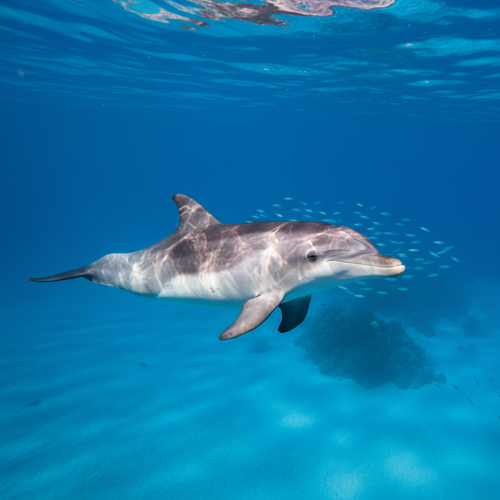
Hector's dolphin is the smallest dolphin species. Mature adults have a total length of 1.2–1.6 m (3 ft 11 in – 5 ft 3 in) and weigh 40–60 kg (88–132 lb). The species is sexually dimorphic, with females being about 5–7% longer than males. The body shape is stocky, with a large fluke relative to their body size and no discernible beak. The most distinctive feature is the rounded dorsal fin, with a convex trailing edge and undercut rear margin. Māui dolphins tend to be longer than South Island Hector's dolphins.

The overall coloration of Hector's dolphins is a mixture of grey, white, and black. Their eyes are surrounded by a black mask, and a thin black line extends from the head to the blowhole. The throat and belly are white, while the rest of the dolphin is grey.
Habitat

Hector's dolphins are endemic to the coastal regions of New Zealand. The South Island Hector's dolphin is most abundant in discontinuous regions of high turbidity around the South Island. They are most abundant off the East Coast and West Coast, most notably around Banks Peninsula, with smaller, more isolated populations off the North Coast and South Coast (notably at Te Waewae Bay). Around Banks Peninsula, some areas are used much more heavily than others; these areas continue to be preferred over decades. Smaller populations are scattered around the South Island, including: Cook Strait, Kaikōura, Catlins (e.g., Porpoise Bay, Curio Bay), and Otago coasts (e.g.Karitane, Oamaru, Moeraki, Otago Harbour, and Blueskin Bay). Māui dolphin are typically found on the west coast of the North Island between Maunganui Bluff and Whanganui.

Diet

Hector's dolphins are generalist feeders, with prey selection based on size (mostly under 10 cm in length) rather than species, although spiny species appear to be avoided. The largest prey item recovered from a Hector's dolphin stomach was an undigested red cod weighing 500 g with a standard length of 35 cm. The stomach contents of dissected dolphins include a mixture of surface-schooling fish, midwater fish, squid, and a variety of benthic species. The main prey species in terms of mass contribution is red cod, and other important prey include flatfish (Peltorhamphus), ahuru (Auchenoceros punctatus), New Zealand sprat (Sprattus muelleri), New Zealand arrow squid (Nototodarus sloanii), and juvenile giant stargazer (Kathetostoma giganteum).

Behaviour

Data from field studies, beached individuals, and dolphins caught in fishing nets have provided information on their life history and reproductive parameters. Photo-ID based observations at Banks Peninsula from 1984 to 2006 show that individuals can reach at least 22 years of age. Males attain sexual maturity between 6 and 9 years old and females begin calving between 7 and 9 years old. Females will continue to calve every 2–3 years, resulting in a maximum of 4–7 calves in one female's lifetime. Calving occurs during the spring and summer. Calves are assumed to be weaned at around one year of age, and the mortality rate in the first 6 months has been estimated to be around 36%.

Humans & conservation

Hector's and Māui dolphin deaths occur as a direct result of commercial and recreational fishing due to entanglement or capture in gillnets or trawls. The species' reliance on shallow areas for foraging brings it in frequent contact with intensive fishing operations. Death is ultimately caused by suffocation, although injury and sub-lethal effects can also result from the mechanical abrasion of fins resulting from entanglement. Since the 1970s, gillnets have been made from lightweight monofilament, which is difficult for dolphins to detect. Hector's dolphins are actively attracted to trawling vessels and can frequently be seen following trawlers and diving down to the net, which could result in the unwanted bycatch.

Part of

Where to see it

No dive sites list Hector's Dolphin yet. Explore the map to find sites near you.