
← All marine life
Hawksbill Sea Turtle
Species IUCN · Critically Endangered (CR)

Hawksbill Sea Turtle

Eretmochelys imbricata, (Linnaeus, 1766)

marine

About Hawksbill Sea Turtle

The hawksbill sea turtle (Eretmochelys imbricata) is a critically endangered sea turtle belonging to the family Cheloniidae. It is the only extant species in the genus Eretmochelys. The species has a global distribution that is largely limited to tropical and subtropical marine and estuary ecosystems.

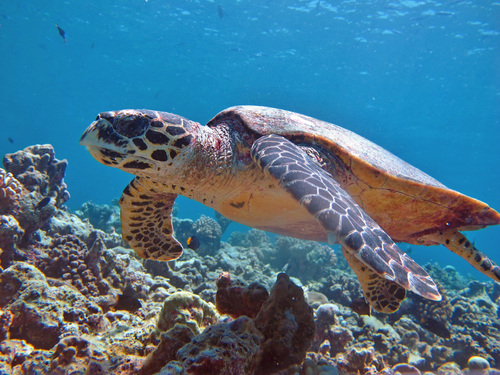
The appearance of the hawksbill is similar to that of other sea turtles. In general, it has a flattened body shape, a protective carapace, and flipper-like limbs, adapted for swimming in the open ocean. E. imbricata is easily distinguished from other sea turtles by its sharp, curving beak with prominent tomium, and the saw-like appearance of its shell margins. Hawksbill shells slightly change colors, depending on water temperature. While this turtle lives part of its life in the open ocean, it spends more time in shallow lagoons and coral reefs.

The World Conservation Union classifies E. imbricata as critically endangered, primarily as a result of human fishing practices. Hawksbill shells were the primary source of tortoiseshell material used for decorative purposes. The Convention on International Trade in Endangered Species regulates the international trade of hawksbill sea turtles and products derived from them.

Appearance

Adult hawksbill sea turtles typically grow to 1 m (3 ft) in length, weighing around 80 kg (180 lb) on average. The heaviest hawksbill ever captured weighed 127 kg (280 lb). The turtle's shell, or carapace, has an amber background patterned with an irregular combination of light and dark streaks, with predominantly black and mottled-brown colors radiating to the sides.

Several characteristics of the hawksbill sea turtle distinguish it from other sea turtle species. Its elongated, tapered head ends in a beak-like mouth (from which its common name is derived), and its beak is more sharply pronounced and hooked than others. The hawksbill's forelimbs have two visible claws on each flipper.
Habitat

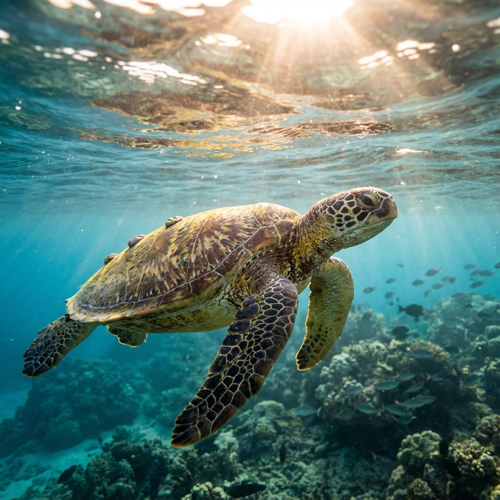
Hawksbill sea turtles have a wide range, found predominantly in tropical reefs of the Indian, Pacific, and Atlantic Oceans. Of all the sea turtle species, E. imbricata is the one most associated with warm, tropical waters. Two significant subpopulations are known, in the Atlantic and Indo-Pacific.

Diet

While they are omnivorous, sea sponges, their principal food, constitute 70–95% of the turtles' diet. However, like many spongivores, they feed only on select species, ignoring many others. Caribbean populations feed primarily on the orders Astrophorida, Spirophorida, and Hadromerida in the class Demospongiae.

Behaviour

Adult hawksbill sea turtles are primarily found in tropical coral reefs. They are usually seen resting in caves and ledges in and around these reefs throughout the day. As a highly migratory species, they inhabit a wide range of habitats, from the open ocean to lagoons and even mangrove swamps in estuaries. Little is known about the habitat preferences of early life-stage E. imbricata; like other young sea turtles, they are assumed to be completely pelagic, remaining at sea until they mature. However, they have been known to seek habitats where they are able to camouflage or hide to minimize predator detection.

Reproduction

Hawksbills mate biannually in secluded lagoons off their nesting beaches in remote islands throughout their range. The most significant nesting beaches are in Mexico, the Seychelles, Indonesia, Sri Lanka, and Australia. The mating season for Atlantic hawksbills usually spans April to November. Indian Ocean populations, such as the Seychelles hawksbill population, mate from September to February. After mating, females drag their heavy bodies high onto the beach during the night. They clear an area of debris and dig a nesting hole using their rear flippers, then lay clutches of eggs and cover them with sand. Caribbean and Florida nests of E. imbricata typically contain around 140 eggs, which hatch after about 60 days. After the hours-long process, the female returns to the sea. Their nests can be found throughout beaches in about 60 countries.

Humans & conservation

Throughout the world, hawksbill turtles have been hunted by humans, though it is illegal to capture, kill, and trade hawksbills in many countries today. In some parts of the world, hawksbill turtles and their eggs continue to be exploited as food. As far back as the fifth century BCE, sea turtles, including the hawksbill, were eaten as delicacies in China.

Beyond direct consumption for food, many cultures have also exploited hawksbill populations for their ornate carapace shells, known variously as tortoiseshell, turtle shell, and bekko.

Part of

Where to see it

No dive sites list Hawksbill Sea Turtle yet. Explore the map to find sites near you.