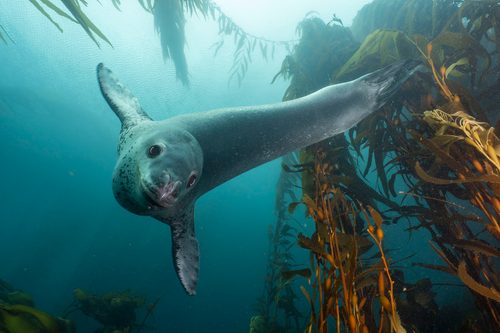
← All marine life
Hawaiian Monk Seal
Species IUCN · Vulnerable (VU)

Hawaiian Monk Seal

Neomonachus schauinslandi, (Matschie, 1905)

marine

About Hawaiian Monk Seal

The Hawaiian monk seal (Neomonachus schauinslandi) is a vulnerable species of earless seal in the family Phocidae that is endemic to the Hawaiian Islands.

The Hawaiian monk seal is one of two extant monk seal species; the other is the Mediterranean monk seal. A third species, the Caribbean monk seal, is extinct. It is the last living member of the genus Neomonachus.

The Hawaiian monk seal is the only seal native to Hawaii, and, along with the Hawaiian hoary bat, is one of only two mammals endemic to the islands.

N. schauinslandi is a conservation reliant species. The small population of about 1,400 individuals is threatened by human encroachment, very low levels of genetic variation, entanglement in fishing nets, marine debris, disease, and past commercial hunting for skins. There are many methods of conservation biology when it comes to endangered species; translocation, captive care, habitat cleanup, and educating the public about the Hawaiian monk seal are some of the methods that can be employed.

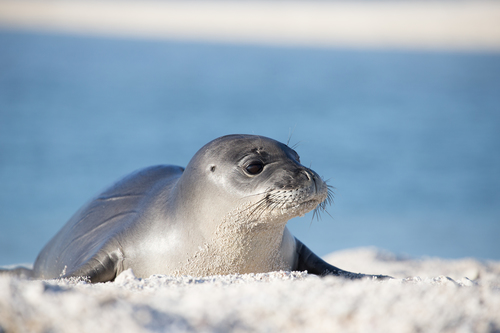
Appearance

Its grey coat, white belly, and slender physique distinguish them from the distantly related harbor seal (Phoca vitulina). The monk seal's physique is ideal for hunting its prey: fish, lobster, octopus and squid in deep water coral beds. When it is not hunting and eating, it generally basks on the sandy beaches and volcanic rock of the Northwest Hawaiian Islands.

Diet

Hawaiian monk seals mainly prey on reef dwelling bony fish, but they also prey on cephalopods and crustaceans. They appear to prefer fish belonging to the families Muraenidae, Labridae, Holocentridae, Balistidae, and Polymixiidae. Both juveniles and sub-adults prey more on smaller octopus species, such as Octopus leteus and O. hawaiiensis, nocturnal octopus species, and eels than the adult Hawaiian monk seals, while adult seals feed mostly on larger octopus species such as O. cyanea. Hawaiian monk seals have a broad and diverse diet due to foraging plasticity which allows them to be opportunistic predators that feed on a wide variety of available prey.

Hawaiian monk seals can hold their breath for up to 20 minutes and dive more than 550 m (1,800 ft); however, they usually dive an average of 6 minutes to depths of less than 60 m (200 ft) to forage at the seafloor.

Behaviour

The majority of the Hawaiian monk seal population can be found around the Northwest Hawaiian Islands but a small and growing population lives around the main Hawaiian Islands. These seals spend two-thirds of their time at sea. Monk seals spend much of their time foraging in deeper water outside of shallow lagoon reefs at sub-photic depths of 300 metres (160 fathoms) or more. Hawaiian monk seals breed and haul-out on sand, corals, and volcanic rock; sandy beaches are more commonly used for pupping. Due to the immense distance separating the Hawaiian Islands from other land masses capable of supporting the Hawaiian monk seal, its habitat is limited to the Hawaiian Islands.

Humans & conservation

Most seals are found on the Northwestern Hawaiian Islands.

The Hawaiian monk seal is endangered, although its cousin species, the Mediterranean monk seal (M. monachus), is even rarer, and the even more closely related Caribbean monk seal (N. tropicalis), last sighted in the 1950s, was officially declared extinct in June 2008. In 2010, it was estimated that only 1100 individuals remained. A later estimate in 2016, which included a more complete survey of small populations, was approximately 1400 individuals.

Part of

Where to see it

No dive sites list Hawaiian Monk Seal yet. Explore the map to find sites near you.