← All marine life
Harlequin Fish
Species IUCN · Least Concern (LC)

Harlequin Fish

Othos dentex, (Cuvier, 1828)

marine

About Harlequin Fish

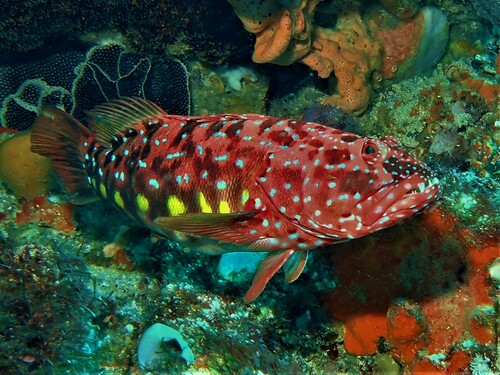
The harlequin fish (Othos dentex) is a species of marine ray-finned fish in the family Anthiadidae. It is the only member of the genus Othos. It is also known commonly as the Chinese lantern, harlequin cod, harlequin rock cod and tiger cod. This species is found in the Eastern Indian Ocean and is endemic to Australian waters, in subtropical areas typically rocky reefs.

Appearance

The harlequin fish is a diurnal forager that has a long life-cycle, a small home range and strong site fidelity. It is likely to be harmed by localized anthropogenic changes and by recreational fishing, though their fishing along the coast is low.

Diet

The harlequin fish is a demersal piscivore, and feeds during daylight. Its mature individuals feed exclusively on fish, and their prey, which is selected for on the basis of their size rather than species, and include species of teleosts, like the Labridae and the Pempheridae. Because juveniles would be unable to ingest prey as large as fishes, its assumed that they feed on other species besides teleosts. It feeds intermittently and its dietary composition lacks seasonality. When this diurnally active species is looking for food, it usually will lie over hard structures and wait for a prey, and when the prey is within range it will dart forward to attack its prey. Its physical appearance as well as the anatomy of its protruding eyes help with its foraging success.

Behaviour

The harlequin fish is native to the temperate waters, and is found over the shallow rocky reefs and in caves located in the cool coast of South-Western Australian waters. It's believed that this reef-dwelling species has an important place in the ecology of its environment since it is a top predator, and is relatively common in the area.

Reproduction

Harlequin fish can live up 42 years, and can grow a maximum length of 75 cm (30 in). In the otoliths of O. dentex, a single opaque zone forms annually, and age of the individual can be determined by the number of these zones. Considering their long life at the young age of 4-5, both the females and males, grow rapidly, with the males showing slight change in color as they reach maturity. Before maturing, the early juveniles are thought to be residing in the crannies and deeper in the caves, which would protect them against predatory piscivorous fish species that exist nearby. As the juvenile individuals approach their mature size, they start moving around the reef. Typically, the male individuals are solitary, and come together with females during spawning season.

Part of

Where to see it

No dive sites list Harlequin Fish yet. Explore the map to find sites near you.