
← All marine life
Grey Seal
Species IUCN · Least Concern (LC)

Grey Seal

Halichoerus grypus, (Fabricius, 1791)

marine

About Grey Seal

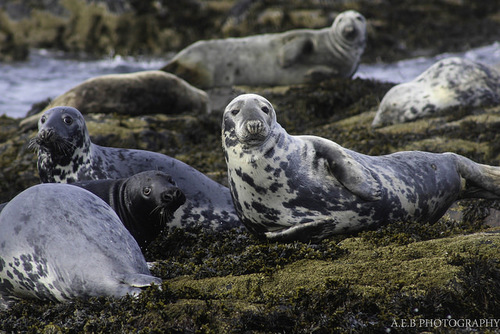
The grey seal (Halichoerus grypus), or gray seal in the United States, is a large seal of the family Phocidae, which are commonly referred to as "true seals" or "earless seals". The only species classified in the genus Halichoerus, it is found on both shores of the North Atlantic Ocean. The name Halichoerus grypus is taken from Ancient Greek via Latin, and means "hook-nosed sea pig". It is also known as the horsehead seal, owing to its large head.

The grey seal is large and heavy, with individuals from the eastern Atlantic being 1.6–2.3 m (5 ft 3 in – 7 ft 7 in) long and weighing 100–310 kg (220–680 lb), while individuals from the western Atlantic are up to 2.7 m (8 ft 10 in) long, and can reach a weight of as much as 400 kg (880 lb). It is found widely across the northern Atlantic, ranging from the US to Russia, and occasionally as far south as Portugal. It can be divided into two subspecies: the Baltic grey seal (Halichoerus grypus grypus), found in the Baltic Sea, and the Atlantic grey seal (Halichoerus grypus atlantica), found everywhere else. The largest populations are in Canada and the UK.

Grey seals have a varied diet, feeding mostly on fish, and occasionally on invertebrates such as octopuses and lobsters. Their main predators are orcas, and they are also prey to sharks. The pups are preyed upon by eagles and gulls.

Appearance

The grey seal is large and heavy: In the eastern Atlantic, males are typically 1.95–2.3 m (6 ft 5 in – 7 ft 7 in) long and weigh 170–310 kg (370–680 lb); the females are much smaller, typically 1.6–1.95 m (5 ft 3 in – 6 ft 5 in) long and 100–190 kg (220–420 lb) in weight. Individuals from the western Atlantic are often much larger, with males averaging up to 2.7 m (8 ft 10 in) and reaching a weight of as much as 400 kg (880 lb) and females averaging up to 2.05 m (6 ft 9 in) and sometimes weighing up to 250 kg (550 lb). Record-sized bull grey seals can reach about 3.3 m (10 ft 10 in) in length. A common average weight in Great Britain was found to be about 233 kg (514 lb) for males and 154.6 kg (341 lb) for females whereas in Nova Scotia, Canada, adult males averaged 294.6 kg (649 lb) and adult females averaged 224.5 kg (495 lb).
Habitat

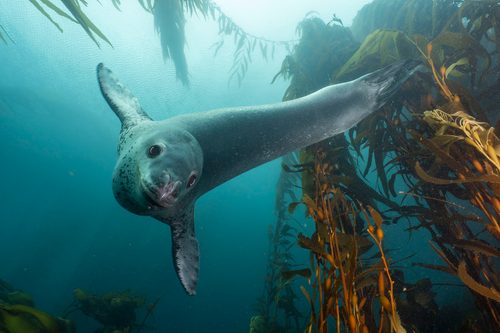
The grey seal is resident to 18 countries: Belgium, Canada, Denmark (including Faroe Islands), Estonia, Finland, France, Germany, Iceland, Ireland, Latvia, Lithuania, the Netherlands, Norway, Poland, Russia, Sweden, the United Kingdom, and the United States of America. It is also an occasional vagrant in Greenland and Portugal. The global population was estimated to be about 632,000 in 2016.

In the UK, the most ecologically significant breeding grounds, classified as Special Areas of Conservation (SACs) Grade A/B, are as follows (percentage of annual UK pup production in parentheses): Monach Islands, Outer Hebrides (20%); Faray and Holm of Faray, Orkney (9%); North Rona, Outer Hebrides (5%); Isle of May, Fife (4.5%); Treshnish Isles, Inner Hebrides (3%); Berwickshire and North Northumberland Coast (2.5%); and Pembrokeshire Marine (2%).

Diet

Grey seals are vulnerable to the typical predators of seals; their primary predator is the orca. Certain large species of sharks are known to prey on grey seals in North American waters, particularly great white sharks and bull sharks. Some grey seal carcasses have washed ashore with visible "cookie cutter" bite marks, a telltale sign of attack by a Greenland shark. In the waters of Great Britain, grey seals are a common prey species for orcas. In the Baltic, grey seal pups are prey for White-tailed eagles and Great black-backed gulls.

Behaviour

Grey seals spend most of their time at sea. They can be seen hauled out on rocks, islands, and shoals not far from shore, occasionally coming ashore to rest. The Baltic subspecies most frequently hauls out at night, beginning right after sunset. This may be related to the behaviour of its main prey species, Atlantic herring, which forms large schools during the day and disperses at night.

Reproduction

Breeding colonies are known as rookeries, and are generally on beaches and remote islands, although in the Baltic and the Gulf of St Lawrence grey seals have been known to occasionally breed on sea ice. Females generally return to the exact location where they were born to give birth, but they sometimes venture to different rookeries.

Females reach sexual maturity at 3–5 years old, while males reach maturity at 6 years. Males, known as bulls, form a territory on the beach, and can mate with more than 6 females, known as cows, a year. Mating can take place on land or in water. The females are pregnant for about 11 and a half months, and give birth to a single pup at the same time each year. Pups weigh 11–20 kg (24–44 lb) at birth, and have dense, soft, silky white fur.

Humans & conservation

Grey seals were nearly extirpated in the United States from hunting for oil, meat, and skins. Bounties were paid on all kinds of seals up until 1945 in Maine and 1962 in Massachusetts. In 2013, there were calls by fishermen in Cape Cod to cull the rising grey seal population, over concerns it was harming the local cod catch.

In 2012, there was a controversial suggestion to cull 70,000 grey seals in the Gulf of St. Lawrence. This was spurred by predictions that the local cod population would be extirpated, with the primary cause attributed to grey seals. However, as of 2026, no such cull has taken place.

Part of

Where to see it

No dive sites list Grey Seal yet. Explore the map to find sites near you.