
← All marine life
Green Jack
Species IUCN · Least Concern (LC)

Green Jack

Caranx caballus, Günther, 1868

marinebrackish

About Green Jack

The green jack (Caranx caballus), also known as the horse jack, is an abundant species of coastal marine fish in the jack family Carangidae. The species is distributed in the eastern Pacific Ocean along the American coastline from Santa Cruz Island off California in the north to Peru in the south, as well as a number of islands including the Galapagos and recently, Hawaii. The green jack is distinguished from other similar carangid species by a number of features including gill raker and lateral line scale counts, and the presence of an adipose eyelid. It is a moderately large species, growing to at least 55 cm in length and 2.81 kg, although unconfirmed reports suggest a much larger maximum size. It lives in a wide range of continental shelf environments including estuaries, bays, reefs and offshore seamounts, living both pelagically and demersally. The green jack is a predatory species, preying on a variety of fish, crustaceans and cephalopods, as well as zooplankton. Most fish are sexually mature by the time they attain 38 cm, with spawning occurring between May and October. The species is of high importance to fisheries throughout its range, caught by pelagic trawls, a variety of netting methods and hook and line. The green jack is also of interest to anglers, taken by bait and lures, although is considered to only be fair in eating quality.

Appearance

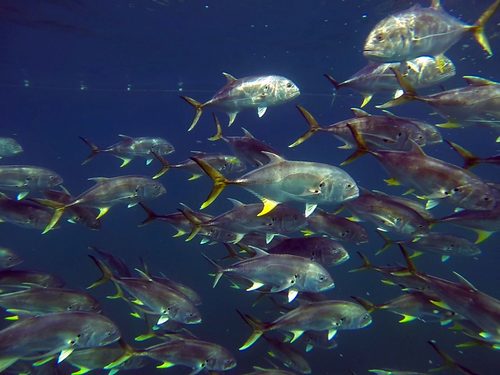
The green jack is moderately large in size, growing to a maximum confirmed length of 55 cm and 2.81 kg in weight. Unconfirmed reports indicate the species may grow much larger; up to 1 m in size, but it is most commonly seen at lengths below 40 cm. The green jack is morphologically similar to a number of other carangids, having an elongated, moderately compressed fusiform body with dorsal and ventral profiles of approximately equal convexity and a slightly pointed snout. The posterior section of the eye is covered by a moderately well developed adipose eyelid, and the posterior extremity of the jaw is vertically under the center of the eye. The dorsal fin is in two parts, the first consisting of 8 spines and the second of 1 spine followed by 22 to 25 soft rays. The anal fin consists of 2 anteriorly detached spines followed by 1 spine and 16 to 21 soft rays.
Habitat

The green jack is distributed throughout the coastal waters of the tropical and subtropical waters of the eastern Pacific Ocean. Its range extends along the coast of the Americas from Santa Cruz Island, California, south through Mexico and Central America, and down to Peru. The species also inhabits a number of offshore islands including the Galápagos Islands. The species had been captured on occasion from the Hawaiian Islands since 1923, but was misidentified until William Smith-Vaniz re-examined the specimens in 1981 and identified them as Caranx caballus. Due to the heavy fishing pressures throughout Hawaii and the rarity of captures, it was concluded these few individuals were strays carried by ocean currents from the eastern Pacific, as these were the only known specimens.

Humans & conservation

The green jack is one of the most abundant species of fish within its range, and as such is quite important to fisheries throughout its range. It is taken by pelagic trawls, inshore gill nets, purse nets, and seines, as well as hook and line gear. Catch statistics are not kept for the fish throughout most of its range; however, the Mexican state of Colima is one exception. Records from 1980 onward show a catch between 9 and 250 tons, with an average of 93 tons, with the catch best between September and December. Like most carangid species in the area, it is considered a lower class product, fetching between US$ 0.50 and 0.80 per kilogram, making it accessible to the low-income population. The fish are sold both for consumption and as bait, either fresh, smoked or salted.

Part of

Where to see it

No dive sites list Green Jack yet. Explore the map to find sites near you.