
← All marine life
Goliath Grouper
Species IUCN · Vulnerable (VU)

Goliath Grouper

Epinephelus itajara, (Lichtenstein, 1822)

marinebrackish

About Goliath Grouper

The Atlantic goliath grouper, the jewfish or itajara (Epinephelus itajara), is a saltwater fish of the grouper family and one of the largest species of bony fish. The species can be found in the West Atlantic ranging from northeastern Florida, south throughout the Gulf of Mexico and the Caribbean Sea, and along South America to Brazil. In the East Pacific it ranges from Mexico to Peru. In the East Atlantic, the species ranges in West Africa from Senegal to Cabinda. The species has been observed at depths ranging from 1 to 100 meters (3 to 300 ft).

Appearance

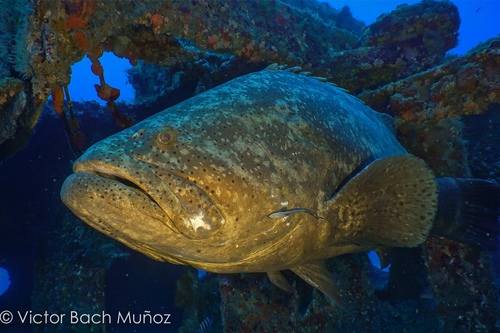
The Atlantic goliath grouper can grow to lengths of 2.5 meters (8 feet) and weigh up to 363 kilograms (800 pounds). The species ranges in coloration from brownish yellow to grey to greenish and has small black dots on the head, body and fins. Individuals less than 1 meter (3 feet) in length have three to four faint vertical bars present on their sides. The species has an elongate body with a broad, flat head and small eyes. The lower jaw has three to five rows of teeth with no front canines. The scales are ctenoid. The dorsal fins are continuous with the rays of the soft dorsal fin being longer than the spines of the first dorsal fin. The pectoral fins are rounded and notably larger than the pelvic fins. The caudal fin is also rounded.

Habitat

Adult individuals are typically found in rocky reefs, wrecks, artificial reefs, and oil platforms. The species can also be found in coral reef habitats, but are much more abundant in rocky reef environments. Juveniles mainly inhabit mangrove environments, but can also be found in holes and under ledges of swift tidal creeks that drain mangroves. Mangroves serve as an essential nursery habitat for the Atlantic goliath grouper and provide specific suitable water conditions to nurture healthy, sustained goliath grouper populations. Juvenile goliath groupers may remain in mangrove nursery habitats for 5 to 6 years before leaving towards deeper offshore reef habitats at around 1 meter in length.

Reproduction

The Atlantic goliath grouper has a longevity of 37 years and reaches first maturity after 6 years, which leads to an estimated generation length of 21.5 years. The species has been hypothesized to be protogynous hermaphrodites, but this has yet to be confirmed. Males become sexually mature at around 115 centimeters (45 in) in length, and at ages 4–6. Females mature at around 125 centimeters (49 in), and at ages 6–8. The species has relatively small spawning aggregations of less than 150 individuals with no evidence of spawning outside of these aggregations.

Humans & conservation

Atlantic goliath groupers are highly susceptible to rapid population decline due to overfishing and the exploitation of spawning aggregations. The species has a brief annual larval settlement period, making the species' abundance extremely vulnerable to outside factors such as poor weather conditions. High mercury concentrations in older males may lead to liver damage and/or death and reduce egg viability. The degradation of mangroves, which serve as an important nursery habitat for the species provide a major threat to juvenile survival. The species was previously classified as critically endangered in 2011 and is currently classified as vulnerable in 2021. A 2016 stock assessment model indicates that there has been an absolute population reduction of around 33% from 1950 to 2014. There has been a complete moratorium on the fishing of this species in continental U.S.

Part of

Where to see it

No dive sites list Goliath Grouper yet. Explore the map to find sites near you.