
← All marine life
Goldspotted Rockcod
Species IUCN · Least Concern (LC)

Goldspotted Rockcod

Epinephelus coioides, (Hamilton, 1822)

marinebrackish

About Goldspotted Rockcod

The orange-spotted grouper (Epinephelus coioides), also known as the brown-spotted rockcod, estuary cod, estuary rockcod, goldspotted rockcod, greasy cod, North-west groper, orange spotted cod or blue-and-yellow grouper, is a species of marine ray-finned fish, a grouper from the subfamily Epinephelinae which is part of the family Serranidae, which also includes the anthias and sea basses. It has an Indo-Pacific distribution and is found in marine and brackish waters.

Appearance

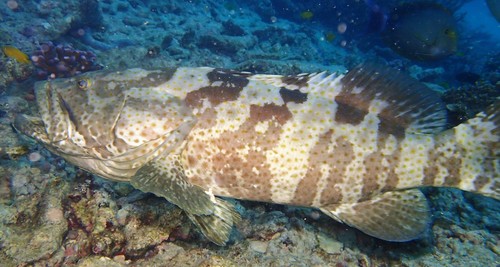
The orange-spotted grouper has an elongate body which has a standard length that is 2.9 to 3.7 times its depth. The dorsal profile of the head is flat or slightly convex between the eyes, the preopercle has enlarged serrations at its angle and a shallow notch just above the angle. The upper margin of the gill cover may be straight or slightly convex. The dorsal fin contains 11 spines and 13-16 soft rays while the anal fin has 3 spines and 8 soft rays. The membranes between the dorsal fin spines are obviously incised. The caudal fin is rounded. There are 58-65 scales in the lateral line. The head and body are light brown on the back lightening to whitish on the underparts. There are four oblique "H-shaped" dark markings on the flanks and 3-4 dark saddle like blotches along the back while the head, body and fins are covered in numerous small brown or orange spots.

Habitat

The orange-spotted grouper has an Indo-Pacific distribution. It is found along the eastern coast of Africa which extends from the Gulf of Suez south as far as Durban in South Africa. It is also found off Madagascar, Mauritius, and Réunion and in the Persian Gulf eastward into the Pacific Ocean as far as Palau and Fiji. Its range extends north to Japan and south to Australia. In Australia it occurs from Carnarvon, Western Australia along the tropical northern coasts to the Solitary Islands in New South Wales. It was observed first in the Mediterranean Sea off Israel in 1969 and has been recorded rarely since. This species has been tested in several countries for mariculture, which is a possible vector for its introduction.

Humans & conservation

Unfortunately, orange spotted groupers have been severely overexploited and fished. In any country where they can be found, their numbers have dwindled or are dwindling. They are mostly targeted using fish traps, and have spectacular tasting flesh which attains a high value in markets. In the UAE, the brunt of the overexploitation is easily visible. It has been assessed that they have been overexploited 7 times the normal level, and fisherman have described: "20 years ago, one net catches you 50kg. Now we use 100 nets and get 10kg of fish". They are slow-growing due to their quite lazy preying methods, mature late, and produce little eggs. The more sought-after larger male fish have been most affected, creating an imbalance between the genders affecting their populations further.

Part of

Where to see it

No dive sites list Goldspotted Rockcod yet. Explore the map to find sites near you.