
← All marine life
Giant Grouper
Species IUCN · Data Deficient (DD)

Giant Grouper

Epinephelus lanceolatus, (Bloch, 1790)

marinebrackish

About Giant Grouper

The giant grouper (Epinephelus lanceolatus), also known as the Queensland grouper (groper), brindle grouper or mottled-brown sea bass, is a species of marine ray-finned fish, a grouper from the subfamily Epinephelinae which is part of the family Serranidae, which also includes the anthias and sea basses. It has a wide Indo-Pacific distribution and is one of the largest extant species of bony fish.

Appearance

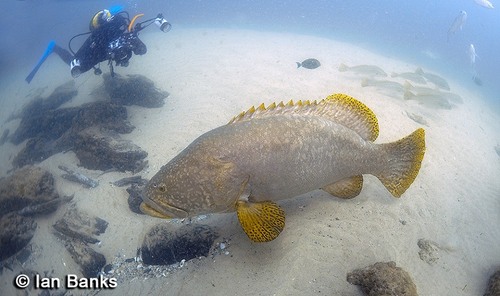
The giant grouper can grow to huge size with the maximum recorded standard length being 270 centimetres (110 in), although they are more common around 180 centimetres (71 in), and a maximum published weight of 400 kilograms (880 lb).

The body is robust, and has a standard length equivalent to 2.4 to 3.4 times its depth. The dorsal profile of the head and the intraorbital area are convex. The preopercle has a rounded corner and a finely serrated margin. The gill cover has a convex upper margin. There are 11 spines and 14–16 soft rays in the dorsal fin while the anal fin has 3 spines and 8 soft rays. The caudal fin is slightly rounded. There are 54 to 62 scales in its lateral line.

Adults are grayish-brown in colour overlain with a mottled pattern and with darker fins. The small juveniles are yellow with wide, dark irregular bars and irregular dark spots on their fins.

Habitat

The giant grouper has a wide Indo-Pacific distribution, it is the most widely distributed species of grouper in the world. It occurs from the Red Sea and the eastern coasts of Africa as far south as Algoa Bay in South Africa and across the Indian Ocean into the Western Pacific Ocean as far east as the Pitcairn Islands and Hawaii. They occur as far north as southern Japan and as far south as Australia.

Diet

The giant grouper is an opportunistic ambush predator which feeds on a variety of fishes, as well as small sharks & batoids (rays), juvenile sea turtles, crustaceans and molluscs which are all swallowed whole. Fish which inhabit coral reefs and rocky areas favour spiny lobsters as prey; a 177-centimetre (70 in) specimen taken off Maui in Hawaii had a stomach content of two spiny lobsters and a number of crabs. Fish living in estuarine environments in South Africa were found to be feeding almost exclusively on the crab Scylla serrata.

Reproduction

Like most groupers, giant groupers are protogynous hermaphrodites. They spawn on a lunar cycle, with spawns lasting about 7 days. They are aggregative broadcast spawners, usually with several females per male. Studies in captive populations suggest that the dominant male and female begin the spawning event as nearly the only spawners for the first day or two, but other members of the aggregation fertilize more eggs as the event progresses, with even the most recently turned males fathering offspring. Giant groupers are diandric protogynous hermaphrodites, meaning that although some males develop from reproductively functional females other males start to produce sperm without ever having gone through a phase as a reproductive female.

Part of

Where to see it

No dive sites list Giant Grouper yet. Explore the map to find sites near you.